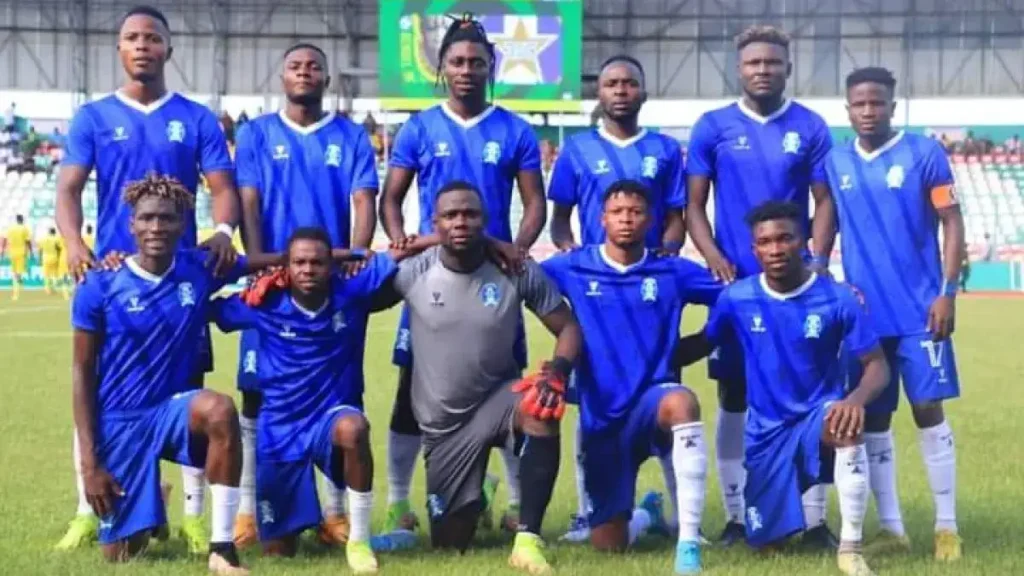

Eboboritse Uwejamomere has described his appointment as Golden Eaglets head coach as the realisation of thirteen years of deliberate preparation, taking charge of a programme that has failed to qualify for three consecutive FIFA U-17 World Cups and three editions of the Africa U-17 Cup of Nations.
When the Nigeria Football Federation handed Eboboritse Uwejamomere the Golden Eaglets job, they were not simply filling a vacancy left by Manu Garba’s departure. They were making a statement about the kind of coaching philosophy they believe the country’s most historically decorated youth programme needs to restore itself after a period of decline that has been as sharp as any in the history of Nigerian age-grade football. Uwejamomere’s response to the appointment, posted on his X account, captured the weight of the moment with a clarity that no press release could have matched.
“It’s a dream come true. Proud to become head coach of the Nigeria U-17 mens national team, the Golden Eaglets, five-time world champions. Over thirteen years of learning, patience, hard work and dedication has led to this moment,” he wrote. The thirteen-year framing is not a rhetorical flourish. It reflects a coaching journey that has taken him through English academy football at Millwall, Gillingham and Nottingham Forest, a UEFA B licence, work as coach-analyst with the senior Super Eagles, involvement with the Super Falcons setup, management of Stormers FC in Nigerian club football, and most recently the role of Head of Academy at Sporting Lagos, one of the country’s most forward-thinking football development organisations.
Want our football coverage to show up first?
Add FootballInNigeria as a preferred source and our stories get a "Preferred" badge in your Google Top Stories, AI Overviews, and AI Mode results.
Nigerian football fans following the Golden Eaglets’ revival alongside the Falconets’ World Cup preparations can use the Bet9ja youth football promo code to stay engaged with Nigeria’s age-grade football calendar through WAFU B qualifying and beyond.
Why The NFF Made This Choice
The federation’s decision to appoint Uwejamomere reflects a deliberate pivot toward modern coaching methodologies. According to officials within the NFF’s youth football department, his selection was driven by his philosophy of structured pressing, tactical flexibility and data-driven performance analysis, qualities that the federation believes can close the gap between Nigeria and countries whose U-17 programmes have modernised more rapidly.
Manu Garba’s tenure, which lasted many years and produced genuine success including Nigeria’s appearances at several U-17 World Cups, had run its course. The federation’s patience with the programme’s recent trajectory ended after a 2-0 semi-final defeat against Ghana in the most recent WAFU B tournament, a result that denied Nigeria qualification for the 2026 Africa U-17 Cup of Nations and the subsequent World Cup. That defeat became the final point in a pattern that the NFF could no longer ignore. The Golden Eaglets had become a programme living on the memory of past glories rather than generating new ones.
Uwejamomere was asked not just to win matches but to rebuild the pipeline itself. NFF officials have set him a specific secondary target beyond tournament qualification: to identify and develop at least five or six players capable of graduating directly into the Flying Eagles U-20 setup. That dual mandate, producing results and producing players, is the kind of challenge that requires exactly the long-term developmental thinking Uwejamomere has spent his career building.
The Decline That Makes The Task So Urgent
| Year | Tournament | Nigeria’s Status |
|---|---|---|
| 2015 | FIFA U-17 World Cup (Chile) | Champions (Osimhen: 10 goals) |
| 2017 | FIFA U-17 World Cup (India) | Did not qualify |
| 2019 | FIFA U-17 World Cup (Brazil) | Quarter-finals |
| 2023 | FIFA U-17 World Cup (Indonesia) | Did not qualify |
| 2025 | FIFA U-17 World Cup (Qatar) | Did not qualify |
| 2026 | Africa U-17 Cup of Nations | Did not qualify (lost to Ghana in WAFU B semis) |
The record above tells a story that would have been unimaginable to anyone who watched Victor Osimhen score a tournament-record 10 goals at the 2015 U-17 World Cup in Chile. Nigeria were five-time world champions, the most successful nation in the history of the competition. A decade later, they have missed three of the last four editions of that same tournament and failed to reach three consecutive editions of their own continental championship. The collapse in fortunes has been dramatic in both its speed and its depth.
The Uwejamomere Philosophy: Why It Fits The Moment
What distinguishes Uwejamomere from the coaches who have preceded him in the Golden Eaglets role is not simply his relative youth or his international experience. It is the specific combination of an analytical mind trained in England’s professional academy system and a deep familiarity with Nigeria’s own youth football landscape. He has seen both environments from the inside, understands what each produces and what each lacks, and has spent more than a decade developing a coaching language that bridges those worlds.
His work at Sporting Lagos gave him direct experience of the challenge of identifying and developing talented young Nigerians within the country’s existing football infrastructure, working with limited resources against clubs with far larger budgets and longer track records. That experience is directly relevant to the Golden Eaglets job, where the talent pool is vast but the identification and development systems have not always functioned at the level the country’s football history demands. Readers following Uwejamomere’s first moves in the role can check the Bet9ja YOHAIG welcome code for the best current registration offer ahead of the September WAFU B qualifying tournament.
The September Test And What Comes After
Uwejamomere’s first competitive assignment is the WAFU B U-17 Boys Championship in September, the qualification pathway for the 2027 Africa U-17 Cup of Nations. The tournament will pit Nigeria against the full strength of West African sub-regional competition, including the Ghana side that ended the previous campaign in the semi-finals. The margin for error is small: only the top qualifiers from WAFU B advance to the continental stage, and a second consecutive failure to navigate the regional hurdle would be an immediate test of the patience the NFF has invested in this appointment.
His technical staff is in place. First assistant Olumide Joseph Ajibolade brings club coaching experience from Beyond Limits FA, second assistant Mohammed Kalli Kachala adds another layer of tactical support, and goalkeepers’ trainer Abdullahi Isa completes a backroom team that the new coach assembled personally after accepting the role.
As reported by FootballInNigeria.com.ng, the broader context around this appointment is a Nigerian football system that is simultaneously managing a senior team World Cup preparation, a Flying Eagles WAFU B campaign in July, a Falconets U-20 Women’s World Cup appearance in Poland in September, and now a Golden Eaglets rebuilding project that begins in the same month. The ambition across Nigeria’s age-grade setup has rarely been more visible or more clearly connected to a common development philosophy. Whether Uwejamomere can deliver on the scale of the opportunity in front of him will become clear on a September afternoon somewhere in West Africa, when the Golden Eaglets take the field for the first time under his guidance. Fans of Nigerian youth football can also use the Bet9ja in-play betting page to follow all qualifying matches live as the WAFU B tournaments approach.
📌 Did You Know?
- Victor Osimhen’s record of 10 goals in a single FIFA U-17 World Cup tournament, set at the 2015 edition in Chile, remains the all-time record for goals scored by a player in a single U-17 World Cup. That performance, which helped Nigeria win the title, was the last time the Golden Eaglets lifted a major international trophy.
- Nigeria were the first African nation to win the FIFA U-17 World Cup, doing so at the inaugural edition of the tournament in 1985 in China, when it was known as the FIFA U-16 World Championship. The 2-0 victory over West Germany in the final announced Nigerian youth football to the world and began a dynasty that spanned four decades.
- Eboboritse Uwejamomere’s coaching education at English professional academy clubs, including Millwall, Gillingham and Nottingham Forest, placed him inside three clubs with historically significant youth development programmes. Millwall’s academy has produced Premier League players across several generations, Gillingham’s has been one of the lower leagues’ most consistent talent suppliers, and Nottingham Forest have an academy with a tradition stretching back to their European Cup-winning era.
- Sporting Lagos, where Uwejamomere served as Head of Academy before his national team appointment, are one of the most progressive football organisations in Nigeria. The Lagos-based club have invested heavily in youth development infrastructure, sports science and coaching education, positioning themselves as a model for how Nigerian football clubs can operate with modern standards.
- Manu Garba, the long-serving Golden Eaglets coach whom Uwejamomere replaces, oversaw Nigeria’s 2013 and 2015 U-17 World Cup victories, making him one of the most successful youth coaches in Nigerian football history. His two consecutive titles placed Nigeria alongside Brazil as the only nations to win back-to-back U-17 World Cups.
- Ghana, the team that defeated Nigeria 2-0 in the WAFU B semi-finals to deny them qualification for the most recent Africa U-17 Cup of Nations, have been one of West Africa’s more consistent performers at U-17 level in recent years. The rivalry between Nigeria and Ghana in youth football has historically been intense, and the September WAFU B tournament is likely to produce another high-stakes meeting between the two neighbours.
- Nigeria’s 2019 U-17 World Cup quarter-final appearance in Brazil, sandwiched between two qualification failures in 2017 and 2023, was the last time the Golden Eaglets reached the knockout stages of a global tournament. That inconsistency across seven years is the core problem Uwejamomere has been appointed to solve.