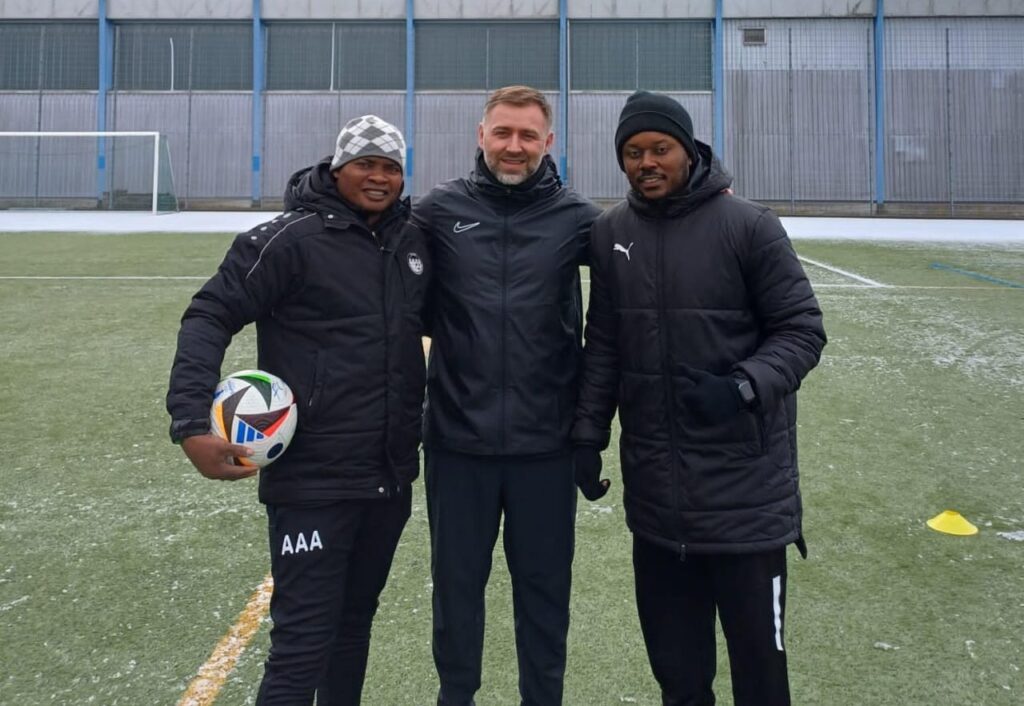
Switzerland-based Nigerian youth football coach Adeyemi Adedeji Anthony has offered an emphatic endorsement of the NFF’s simultaneous appointments of Abdu Maikaba and Eboboritse Uwejamomere, saying the double selection places the future of Nigerian youth football in safe hands.
When a coach working within European youth football systems validates appointments made by the NFF’s youth football department, the endorsement carries a particular weight. Adeyemi Adedeji Anthony is based in Switzerland, a country whose football development infrastructure is consistently regarded as among the most technically sophisticated in European youth football, and his assessment of Maikaba and Uwejamomere as men with rich CVs and the capacity to deliver reflects a reading of both coaches that goes beyond geography and national loyalty.
“Congratulations to the coaches, well deserved. They have rich CVs and I believe the future of Nigeria football is in safe hands,” Adeyemi told FootballInNigeria.com.ng. His response came directly after the NFF’s confirmation of both appointments, which placed Maikaba in charge of the Flying Eagles U-20 squad heading into July’s WAFU B Championship and handed Uwejamomere the task of rebuilding the Golden Eaglets U-17 programme ahead of the September WAFU B qualifying tournament.
Want our football coverage to show up first?
Add FootballInNigeria as a preferred source and our stories get a "Preferred" badge in your Google Top Stories, AI Overviews, and AI Mode results.
Nigerian youth football supporters following both appointments ahead of the WAFU B campaigns can use the Bet9ja youth football promo code to stay connected with all the age-grade national team news as camp preparations begin in Abuja on Sunday.
Why Maikaba’s Flying Eagles Past Matters
Adeyemi reserved particular attention for Maikaba’s specific advantage over a coach being brought into the Flying Eagles role cold. The new head coach’s prior involvement with the U-20 setup, as an assistant in the Flying Eagles camp during an earlier cycle, gives him institutional familiarity that cannot be manufactured quickly in any coaching appointment.
“Maikaba is a very experienced coach and being a former assistant in the Flying Eagles setup will surely help him hit the ground running,” Adeyemi said. That insight speaks directly to one of the most persistent challenges in Nigerian youth football management: the time it takes for a new coach to understand the specific culture, player pool, and qualification dynamics of the age-grade system before they can make informed selection decisions. Maikaba has already navigated that learning curve from inside the same squad structure. When camp opens on Sunday in Abuja, he will not be starting from scratch.
His domestic coaching record, which includes the NPFL title with Kano Pillars in 2014-15, adds a further layer of credibility that Adeyemi’s reference to “rich CVs” acknowledges directly. Winning a domestic league title requires tactical intelligence, man-management, and the ability to handle pressure in high-stakes situations, all qualities that translate directly into the tournament football environment the Flying Eagles will face at WAFU B in July.
Uwejamomere’s Grassroots Knowledge: The Missing Piece
For the Golden Eaglets appointment, Adeyemi’s emphasis fell on a different quality. Where Maikaba’s advantage is experience within the system, Uwejamomere’s advantage is a depth of knowledge about young Nigerian footballers at their formative stages, before they reach the national team radar, that coaches who have operated primarily at senior level often lack.
“Ebo Uwe is vast in knowledge with young footballers and the combination of top grassroots coaches promises exciting times ahead for the revival of the Golden Eaglets. I wish them all the best on the job,” Adeyemi said. The phrase “combination of top grassroots coaches” is specific: it refers to Uwejamomere’s backroom team, which brings in Olumide Joseph Ajibolade from Beyond Limits FA as first assistant and draws on multiple coaches who have worked directly in Nigerian club academies and development structures. That combination, Adeyemi is suggesting, creates a technical bench that can identify and develop the right players rather than simply working with whoever happens to be visible at the time of squad assembly. Readers following both coaches’ first weeks on the job can also check the Bet9ja YOHAIG code for new users for the best current registration offer.
The Appointments In Full
| Team | Head Coach | First Target | Camp Opens |
|---|---|---|---|
| Flying Eagles (U-20) | Abdu Maikaba | WAFU B U-20 Championship (July 2026) | Sunday, May 17 (Abuja) |
| Golden Eaglets (U-17) | Eboboritse Uwejamomere | WAFU B U-17 Championship (September 2026) | To be confirmed |
What The Diaspora Perspective Adds
Adeyemi’s base in Switzerland gives his verdict a dimension that domestic Nigerian coaching voices cannot always provide. He operates within a youth football environment that produces technically sophisticated players and coaches at the Under-12 through Under-21 levels with remarkable consistency, and his ability to compare what he sees in the European development model with the appointments the NFF has made allows him to evaluate whether Nigeria’s choices are moving in a direction that international youth football demands.
Swiss football’s youth development philosophy emphasises structure, tactical education, and long-term player development over short-term results, qualities that align closely with what both Maikaba and Uwejamomere have spoken about in their early public comments since taking their respective roles. Maikaba’s record of building organised, tactically coherent teams at NPFL club level and Uwejamomere’s emphasis on data analysis and structured pressing both reflect a coaching language that Adeyemi, working in the Swiss system, would recognise as appropriate for the modern demands of international youth football.
The Bigger Picture: Youth Football’s Moment Of Renewal
Both appointments arrive at a critical juncture for Nigerian youth football. The Flying Eagles carry the weight of seven Africa U-20 Cup of Nations titles and the expectation that accompanies that record. The Golden Eaglets carry five FIFA U-17 World Cup titles and a legacy that the programme has spent several years struggling to sustain after the back-to-back 2013 and 2015 triumphs.
External voices like Adeyemi’s matter at moments like this because they confirm, from an independent and internationally informed position, that the NFF’s appointments are not simply the product of internal political considerations but reflect genuine quality in the men chosen. As reported by FootballInNigeria.com.ng, both coaches begin their work this week with full backroom teams in place, clear qualification targets on the calendar, and a growing chorus of support from inside and outside the Nigerian football community. Whether that support translates into WAFU B titles and continental qualification will be determined over the coming months, but the starting point is as coherent and purposeful as Nigerian youth football management has looked in several years. Fans of Nigerian youth football tracking both squads’ preparations through WAFU B can also use the Bet9ja today’s games page for all live updates during qualifying fixtures.
📌 Did You Know?
- Switzerland’s football development model is overseen by Swiss Football Association (SFV/ASF) and has produced several players who reached the top of European club football, including Granit Xhaka, Xherdan Shaqiri, and Ricardo Rodriguez. The country’s youth development philosophy prioritises technical skill and tactical intelligence from the earliest age groups, making it one of the more respected systems in European football administration.
- Abdu Maikaba’s previous involvement with the Flying Eagles as an assistant coach gives him direct experience of the specific qualification pathways, player identification challenges, and tournament dynamics of Nigerian U-20 football. That institutional knowledge is particularly valuable given the compressed timeline between Sunday’s camp opening and July’s WAFU B tournament.
- Eboboritse Uwejamomere’s nickname “Ebo Uwe” reflects the informal but affectionate way Nigerian football communities refer to coaches and players who have built grassroots credibility over many years. The shortening of his surname into a recognisable two-syllable form signals a familiarity with his work among Nigerian football insiders that predates his national team appointment.
- The WAFU B sub-region’s U-20 Championship, which the Flying Eagles must win to qualify for the 2027 Africa U-20 Cup of Nations, has historically featured Nigeria, Ghana, Senegal, Ivory Coast, and Burkina Faso as the strongest competing nations. The regional competition’s quality means Nigeria cannot approach it without full preparation, making the Sunday camp opening a genuinely urgent first step.
- Nigeria’s Flying Eagles have won the Africa U-20 Cup of Nations seven times, more than any other country in the tournament’s history. Their titles came in 1983, 1985, 1987, 1989, 1991, 2005 and 2015, a span of 32 years that reflects both the depth and the inconsistency of Nigerian youth football development across different eras.
- Beyond Limits FA, the club from which first assistant Olumide Joseph Ajibolade joins the Golden Eaglets backroom team, is one of Nigeria’s most active football academies in terms of player development and participation in domestic youth competitions. The club’s inclusion in the Eaglets’ technical staff reflects the NFF’s interest in drawing on grassroots institutional knowledge alongside formal coaching credentials.
- The simultaneous appointment of new head coaches for both the Flying Eagles and the Golden Eaglets in the same week is one of the more coordinated moments of NFF youth football planning in recent years, allowing the federation to align both programmes’ development timelines and share administrative resources across the two squads’ preparation schedules.