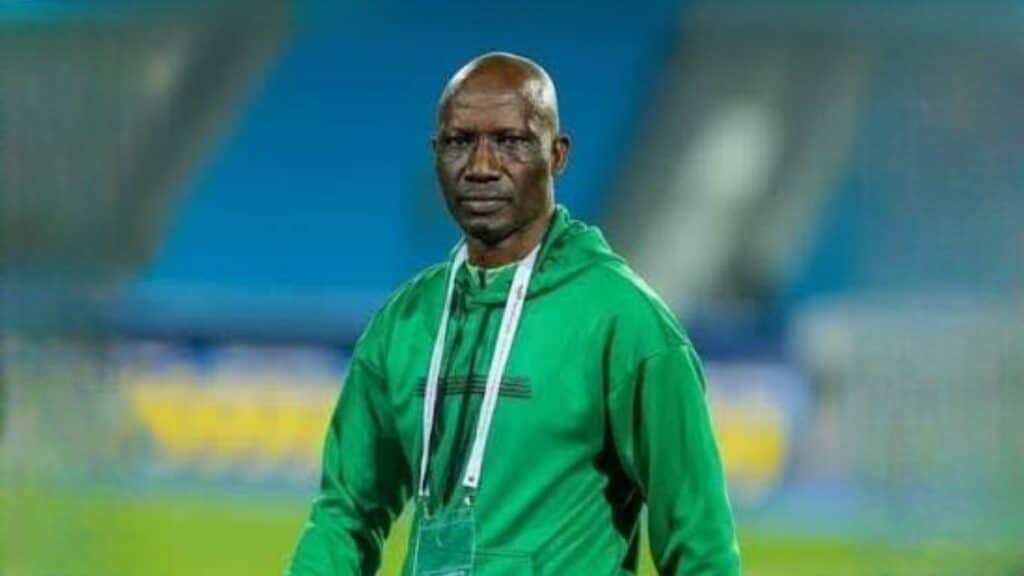
Ladan Bosso has confirmed to FootballInNigeria.com.ng that he wants the Nigeria U-23 Olympic Eagles coaching job, entering a race that already features Samson Siasia and Daniel Amokachi as the NFF works through its shortlist for one of Nigerian football’s most consequential age-grade appointments.
Ladan Bosso did not wait to be approached. The 58 year old chairman of the Nigeria Football Coaches Association confirmed his candidacy directly, making clear in a conversation with FootballInNigeria.com.ng that he is interested in the vacancy and prepared to make his case to the NFF whenever the federation is ready to hear it. “Yes, I’m also interested in the job,” he said. “We’re waiting for the NFF to make their decision.”
The brevity of that statement should not be mistaken for passivity. Bosso has spent decades building a coaching record in Nigerian football that covers some of the country’s most historically significant clubs, and his prior experience at national team level guiding the Flying Eagles to the quarter finals of the 2007 FIFA U-20 World Cup in Canada gives him a specific credential that neither Siasia nor Amokachi can claim in the U-20 context. His entry into the U-23 race adds a third serious domestic coaching voice to a vacancy that the NFF has been considering carefully.
Want our football coverage to show up first?
Add FootballInNigeria as a preferred source and our stories get a "Preferred" badge in your Google Top Stories, AI Overviews, and AI Mode results.
Nigerian football fans following the U-23 Eagles coaching appointment can use the Bet9ja youth football code to stay connected with all the age grade national team news as the NFF finalises its decision ahead of the Los Angeles 2028 Olympic qualification cycle.
The Three Main Candidates In Contention
| Candidate | Previous Nigeria Role | Key Credential |
|---|---|---|
| Ladan Bosso | Flying Eagles (U-20) coach | 2007 FIFA U-20 World Cup QF; NFCA chairman |
| Samson Siasia | Super Eagles coach; U-23 coach | 2016 Olympic Games — bronze medal |
| Daniel Amokachi | Super Eagles assistant coach | 1994 World Cup; UCL winner with Ajax |
Each candidate brings something the others do not. Siasia has the most specific credential for this exact job he managed the U-23 Eagles to the 2016 Olympics in Rio de Janeiro, where they won bronze in one of the most celebrated results in Nigerian football history. His track record in the role is not simply positive it is one of the best outcomes any Nigerian U-23 coach has delivered at an Olympic Games. Former Nigerian international Kalika specifically identified Siasia as the best fit for the role in a separate assessment covered earlier this week, citing that track record as definitive. Amokachi brings his own pedigree as a World Cup scorer and Champions League winner with Ajax who has transitioned into coaching, while Bosso’s institutional role as NFCA chairman gives him a platform and a relationship with the domestic coaching community that neither of the other candidates can match. Readers following the appointment race can check the Bet9ja YOHAIG national team code for the best current registration deal.
The Weight Of Bosso’s Domestic Coaching Record
Ladan Bosso’s club career is one of the most geographically diverse in the history of Nigerian domestic football coaching. His list of previous clubs Kano Pillars, Wikki Tourists, Bayelsa United, Abia Warriors, Barau FC and El-Kanemi Warriors spans the north, southeast, south-south and northeast of Nigeria, giving him a familiarity with different regional football cultures and talent pools that is rare even among the most experienced domestic coaches. A U-23 Eagles coach who understands where to look for talent across Nigeria’s different football heartlands has a specific advantage over one whose domestic scouting exposure is narrower.
His 2007 FIFA U-20 World Cup quarter-final run with the Flying Eagles remains the most high-profile result he has delivered in a national team context, and the fact that he is now the chairman of the Nigeria Football Coaches Association gives his candidacy an institutional dimension. The NFCA represents domestic coaches across the country, and Bosso’s leadership of that body reflects the respect his peers have for his experience and judgment. Whether the NFF regards that combination as sufficient to compete with Siasia’s specific Olympic track record is the central question his candidacy poses.
What The U-23 Eagles Job Actually Requires
The Olympic Eagles, as the U-23 squad is known in qualification and tournament play, face a specific challenge heading into the 2026-27 cycle. The 2028 Los Angeles Olympic Games will require Nigeria to qualify through the CAF U-23 Africa Cup of Nations, the outcome of which determines the African nations who reach Los Angeles. A new head coach will need to identify and develop the right players across a qualification window that begins before the end of 2026 and arrives at its most critical junctures in 2027.
The importance of the U-23 role for the broader Super Eagles pipeline is something that former international Alloy Agu emphasised in his exclusive interview covered earlier in this session the U-23 Eagles function as a semi-Super Eagles team, with players graduating from the Olympic setup directly into the senior squad. Who coaches that pipeline matters as much for the long-term health of the Super Eagles as the immediate qualification outcomes. As reported by FootballInNigeria.com.ng, the NFF has not yet announced its decision, and all three candidates remain in contention as the federation completes its deliberations. Bosso’s public confirmation of his interest ensures that the domestic coaching community is represented in a shortlist that might otherwise have been dominated by names with higher international profiles but less recent NPFL exposure. Fans following the appointment developments can also use the Bet9ja express page for the latest offers as the Nigerian football summer calendar builds toward the World Cup and beyond.
📌 Did You Know?
- Ladan Bosso guided the Flying Eagles to the quarter-finals of the 2007 FIFA U-20 World Cup in Canada, where Nigeria was eliminated by Argentina. That edition of the tournament was won by Austria, with Argentina, Czech Republic and Chile completing the semi-final line-up. Bosso’s side reached the last eight in one of the competition’s most competitive editions.
- Samson Siasia’s U-23 Eagles won the bronze medal at the 2016 Rio de Janeiro Olympics, defeating Honduras 3-2 in the third place play off. Earlier in that tournament, Nigeria had beaten Germany 3-2, one of the most celebrated results in recent Olympic football history, before losing to Brazil in the semi-finals.
- Daniel Amokachi scored two goals for Nigeria at the 1994 FIFA World Cup in the United States, including a substitute goal against Greece that became one of the tournament’s most talked about selections after coach Clemens Westerhof appeared to have sent him on without fully intending to replace the player who left the field. His Champions League winners’ medal came with Ajax in 1995.
- The Nigeria Football Coaches Association (NFCA), which Bosso chairs, represents professional football coaches across the domestic game and advocates for coaches’ welfare, professional development, and employment rights. The organisation’s relationship with the NFF gives its chairman a direct line of communication with the federation’s administration.
- Wikki Tourists of Bauchi, one of Bosso’s former clubs, were relegated from the NPFL in 2025-26 and will play in the NNL next season. Their exit from the top flight, covered in this session’s NPFL final-day reporting, represents a loss for the northern football ecosystem that Bosso has been closely associated with across his coaching career.
- The 2028 Los Angeles Olympic Games will be the first Olympics held in the United States since the 1996 Atlanta Games, where Nigeria famously won football gold by beating Argentina and Brazil in consecutive knockout matches. The prospect of Nigeria competing in Los Angeles carries the specific emotional weight of that 1996 memory for every Nigerian football supporter who was alive to witness it.
- Nigeria has won Olympic football gold once, at Atlanta 1996, and bronze twice at Athens 2008 under Samson Siasia and Rio 2016 also under Siasia. The consistency of medal performance under Siasia’s specific management of the U-23/Olympic programme is the most cited reason for his candidacy in the current appointment process.