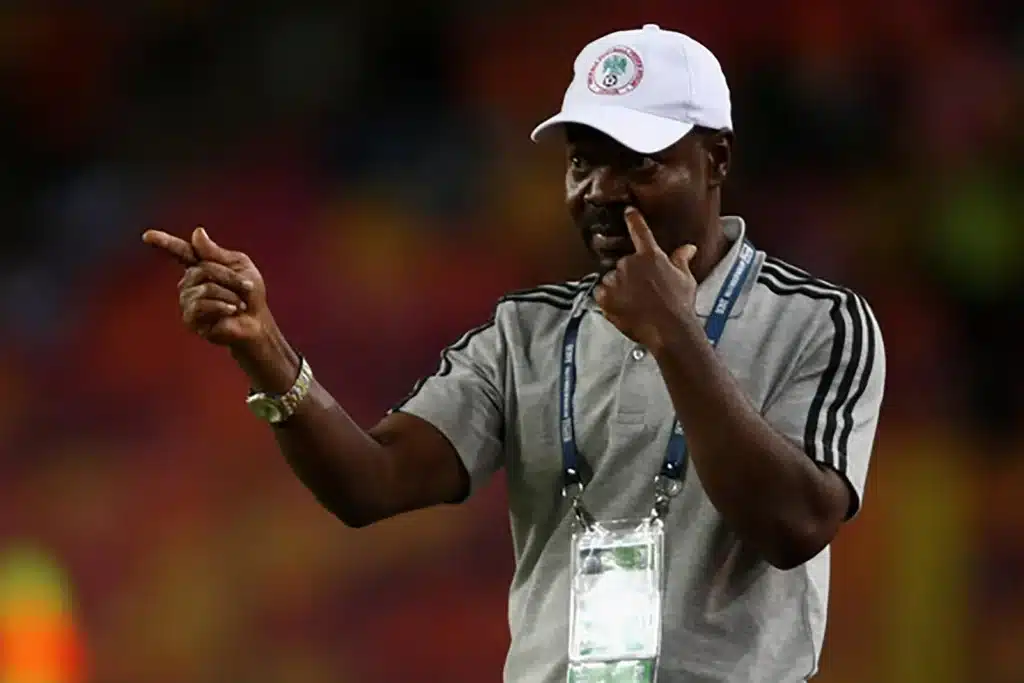
John Obuh has named the problem in the Golden Eaglets setup with blunt clarity: agents and administrators forcing their players into squads, coaches too afraid to resist, and a culture of impunity that has steadily hollowed out Nigeria’s proud U-17 tradition.
John Obuh spent decades working in Nigerian youth football, including leading the Golden Eaglets to a silver medal at the 2009 FIFA U-17 World Cup in Nigeria. When he speaks about what has gone wrong at that level, it is not from the sidelines as a casual observer. It comes from the inside, and his diagnosis is pointed.
Speaking to Brila FM, Obuh placed the blame for Nigeria’s recent struggles at the under-17 level squarely on external interference in player selection. Agents pushing their clients into squads, administrators demanding that certain players be included, and coaches too politically exposed to resist. The result, he argued, is teams that are built on compromise rather than merit, and they perform accordingly.
Want our football coverage to show up first?
Add FootballInNigeria as a preferred source and our stories get a "Preferred" badge in your Google Top Stories, AI Overviews, and AI Mode results.
“I think there is a lot of interruptions in the selection of players today. A lot of people want their players to be picked,” he said. “There’s the question of nepotism and tribalism.” As reported by FootballInNigeria.com.ng, these are concerns that veteran Nigerian football administrators have raised repeatedly over the years, but rarely with this much directness from someone who has held the head coach role himself.
The Coach Autonomy Problem
Obuh’s sharpest critique was directed not just at the interferers but at the coaches themselves. He argued that the root of the dysfunction is a lack of courage among technical staff to stand by their selections even when under pressure.
“We don’t have a coach that will say, ‘I am selecting my team, if I fail, sack me,'” he said. “Unfortunately, most of them today play to the hands of the person who gave them the job. When they fail, it becomes a problem no one will come to own up, and they will sack you. So let the coaches who are given this job stand their ground and take the best out of the players they feel are qualified. If they fail, sack them but allow them to do their job.”
The logic is simple and unassailable. A coach who builds their squad around the best available players is the only coach with any chance of winning. A coach who builds it around relationships and obligations is managing a political network, not a football team. Nigeria’s youth football has suffered the consequences of the latter approach for too long. Nigerian football fans who want to back the next generation at upcoming youth tournaments can use the Bet9ja welcome bonus page for new user offers.
Amuneke and the Question of Attention
Obuh also addressed the return of Emmanuel Amuneke to the Nigerian youth football setup. Amuneke won the FIFA U-17 World Cup with the Golden Eaglets as coach in 2015, making him one of the most successful figures in that programme’s history. His involvement has been welcomed in many quarters, but Obuh pointed out that the identity of the coach is not the primary issue.
“Bringing the likes of Amuneke back, who won with the Eaglets, isn’t the issue; it’s the attention being given to them that matters,” he said. “If you give the team attention and work that team up to want to get results, you will definitely get results.”
The word “attention” carries weight here. Preparation quality, consistent training camps, adequate resources, and an environment free from the distractions of agent lobbying and administrative interference. These are the conditions under which any coach, including one with Amuneke’s record, can actually do the job properly. Without them, even a gifted tactician is building on sand. New Bet9ja users can follow the Golden Eaglets’ upcoming qualifying campaign by using the YOHAIG promo code for their first deposit. For a complete guide on how Nigeria’s Bet9ja bonus works, the Bet9ja bonus guide has all the details.
A Record Worth Protecting
Nigeria’s record at the FIFA U-17 World Cup remains among the finest of any nation globally, with five World Cup titles and a tradition of producing technical, fearless, tactically intelligent teenagers. The names that came through that programme, from Nwankwo Kanu to John Obi Mikel to Victor Osimhen, represent a lineage that millions of Nigerian football fans take genuine pride in. Allowing agent interference and tribalism to corrode that record is not just a football problem; it is a squandering of one of the most productive talent pipelines in world football. Obuh’s message is clear: fix the selection process, give coaches the room to do their jobs, and the results will follow.
📌 Did You Know?
- Nigeria has won the FIFA U-17 World Cup five times, in 1985, 1993, 2007, 2013, and 2015, making them the most successful nation in the history of that tournament by number of titles.
- John Obuh led the Golden Eaglets to the final of the 2009 FIFA U-17 World Cup held in Nigeria, where they lost to Switzerland, earning a silver medal on home soil in front of a passionate Nigerian crowd.
- Emmanuel Amuneke won the FIFA U-17 World Cup as Golden Eaglets coach in 2015 in Chile, where Nigeria beat Mali 2-0 in the final, cementing his place as one of the most successful figures in Nigerian youth football administration.
- Agent interference in youth team selection is a recognised problem across African football, with federation officials in several countries having acknowledged that pressure from intermediaries representing academy players distorts squad selection at age-group level.
- Victor Osimhen, currently Nigeria’s most prominent senior international, rose to global attention through the Golden Eaglets setup, scoring ten goals at the 2015 FIFA U-17 World Cup to finish as the tournament’s top scorer at just 16 years old.
- Nigeria failed to qualify for the 2025 FIFA U-17 World Cup in Qatar, missing the tournament for the second consecutive edition after also being absent from the 2023 edition in Indonesia, a trend that Obuh’s comments directly address.
- The pipeline from Nigeria’s age-group football to the senior Super Eagles squad has historically been one of the most productive in Africa, but the recent U-17 absences from World Cup tournaments represent a genuine disruption to that talent flow if they continue.