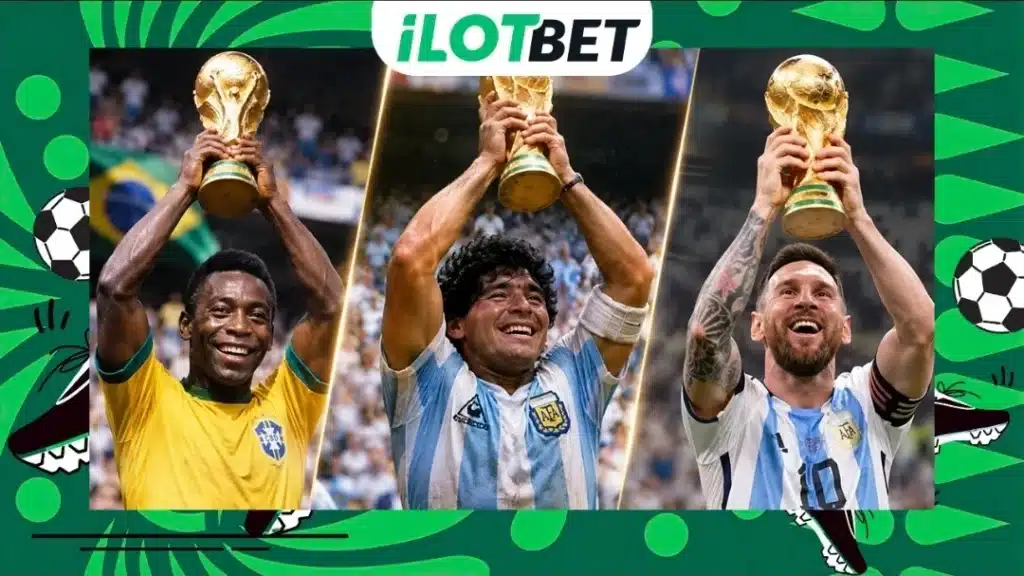
There is no greater stage in football than the FIFA World Cup. It is where reputations are made, heroes are born, national dreams are realized and, sometimes, the finest careers are defined by a single moment.
For some players, greatness is measured by the number of goals they score. For others, it is the trophies they lift, the finals they influence or the extraordinary performances that remain etched in the memories of generations.
But the World Cup demands something different. It demands excellence under the greatest pressure, against the strongest opposition, with an entire nation watching.
Want our football coverage to show up first?
Add FootballInNigeria as a preferred source and our stories get a "Preferred" badge in your Google Top Stories, AI Overviews, and AI Mode results.
The tournament has produced extraordinary footballers, from the elegance of Zinedine Zidane and the brilliance of Diego Maradona to the goalscoring exploits of Gerd Müller and Ronaldo Nazário.
The 2026 edition has added another remarkable chapter. Kylian Mbappé has become the competition’s all-time leading goalscorer, and Lionel Messi has extended his record for World Cup appearances.
Yet, being a great footballer and being a great World Cup player are not necessarily the same thing.
This ranking considers performances across World Cup tournaments, individual influence, goals, consistency, trophies, decisive moments and the ability to elevate a national team when it mattered most.
It is a ranking of World Cup careers, rather than an assessment of who was the best footballer in their prime.
Here are the 10 greatest World Cup players in history, counting down from number 10.
10. Gerd Müller (West Germany)
- World Cups: 1970, 1974
- Appearances: 13
- Goals: 14
- Titles: 1 (1974)
Few strikers in World Cup history have been as devastating in front of goal as Gerd Müller.
The German forward was the definition of a penalty-box predator. He did not necessarily possess the elegance of some of the game’s greatest attacking players, but his movement, anticipation, positioning and extraordinary finishing made him almost impossible to contain.
His 1970 World Cup campaign was particularly remarkable. Müller scored 10 goals in six matches, winning the Golden Boot and finishing as the tournament’s outstanding goalscorer.
He scored hat-tricks against Bulgaria and Peru in the group stage before continuing his remarkable run in the knockout rounds. His goals helped West Germany reach the semi-finals, where they suffered a heartbreaking 4-3 extra-time defeat against Italy in what became known as the ‘Game of the Century’.
Four years later, Müller returned to the competition and played an instrumental role in West Germany’s triumph on home soil.
His defining contribution came in the 1974 final against the Netherlands. With the score at 1-1, Müller controlled a pass inside the penalty area, turned and fired past Jan Jongbloed to secure a 2-1 victory.
It was the winning goal in a World Cup final and the perfect illustration of his extraordinary instincts.
Müller finished his World Cup career with 14 goals in just 13 appearances. His scoring rate remains one of the most impressive in the competition’s history.
9. Miroslav Klose (Germany)
- World Cups: 2002, 2006, 2010, 2014
- Appearances: 24
- Goals: 16
- Titles: 1 (2014)
For years, Miroslav Klose represented the ultimate benchmark for World Cup goalscoring.
He may not have enjoyed the global celebrity of Ronaldo, Messi or Cristiano Ronaldo, but his performances on football’s biggest stage were extraordinary.
Klose announced himself at the 2002 World Cup in South Korea and Japan, scoring five goals as Germany reached the final before losing 2-0 to Brazil.
His aerial ability became a particularly dangerous weapon, with his trademark celebrations after scoring headers becoming familiar sights.
He repeated the five-goal achievement at the 2006 tournament on home soil, winning the Golden Boot as Germany finished third.
Four years later, he scored four more goals in South Africa, taking his World Cup tally to 14.
But his greatest achievement came in Brazil in 2014.
Klose scored twice during the tournament, including the historic goal against Brazil in Germany’s astonishing 7-1 semi-final victory. That strike took him past Ronaldo Nazário’s previous record of 15 World Cup goals.
He eventually finished his career with 16 goals, a record that stood until the 2026 tournament.
Klose also had the distinction of appearing in four consecutive World Cup semi-finals, reaching two finals and winning one.
8. Zinedine Zidane (France)
- World Cups: 1998, 2002, 2006
- Appearances: 12
- Goals: 5
- Titles: 1 (1998)
Some players influence football matches. Others make them look like performances arranged specifically for their enjoyment.
Zinedine Zidane belonged to the latter category.
The French midfielder combined extraordinary technical ability, composure, vision and intelligence. His performances at the 1998 and 2006 World Cups demonstrated why he remains one of the most influential midfielders ever to grace the competition.
At France 1998, Zidane helped his country win its first World Cup on home soil.
A red card against Saudi Arabia in the group stage cost him two matches through suspension, but he returned to score twice with headers in the final against Brazil, securing a memorable 3-0 victory.
Those two goals transformed him into a national icon and established his place in French football history.
The 2002 tournament was disappointing, with France eliminated in the group stage without scoring a single goal. Zidane had arrived carrying an injury and was unable to make the impact expected of him.
However, Germany 2006 provided another extraordinary chapter.
At 34, Zidane inspired France to the final, producing outstanding performances against Brazil and Portugal. His penalty in the final against Italy, a daring Panenka that struck the crossbar before crossing the line, remains one of the competition’s most memorable moments.
Unfortunately, his tournament ended in controversy when he was sent off for headbutting Marco Materazzi in extra time.
France eventually lost on penalties.
Zidane won the Golden Ball as the tournament’s best player despite that controversial ending.
His World Cup career was not perfect, but his ability to dominate matches at the highest level makes him one of the competition’s most memorable figures.
7. Garrincha (Brazil)
- World Cups: 1958, 1962, 1966
- Appearances: 12
- Goals: 5
- Titles: 2 (1958, 1962)
Garrincha’s story is one of football’s most extraordinary examples of individual brilliance.
Born with physical abnormalities that left his legs bowed, the Brazilian winger overcame enormous challenges to become one of the most devastating dribblers the game has ever witnessed.
His ability to deceive defenders was almost impossible to explain. He could change direction, accelerate and manipulate the ball in ways that left opponents helpless.
Although he was part of Brazil’s victorious 1958 squad, it was the 1962 World Cup in Chile that established his legendary status.
With Pelé injured during the group stage, Brazil needed another player to take responsibility. Garrincha answered emphatically.
He scored twice against England in the quarter-finals before producing another two-goal performance against Chile in the semi-finals.
Brazil eventually defeated Czechoslovakia 3-1 in the final, successfully defending their world title.
Garrincha’s performances were so influential that he shared the Golden Boot with five other players, having scored four goals, and was awarded the Golden Ball as the tournament’s best player.
His importance to that Brazilian triumph cannot be overstated. With Pelé unavailable, Garrincha effectively carried the attacking responsibility of a nation.
He remains one of the few players whose individual brilliance became synonymous with an entire World Cup campaign.
6. Franz Beckenbauer (West Germany)
- World Cups: 1966, 1970, 1974
- Appearances: 18
- Goals: 5
- Titles: 1 (1974)
Franz Beckenbauer changed the way football understood defensive responsibility.
Before the German legend, defenders were primarily expected to stop opponents from scoring. Beckenbauer demonstrated that a defender could also dictate the rhythm of a match, initiate attacks and influence the game from deep positions.
His interpretation of the sweeper role became one of football’s most influential tactical innovations.
Beckenbauer’s World Cup career began in 1966, when West Germany reached the final before losing to England.
He scored four goals during that tournament, an extraordinary contribution for a player operating largely from midfield and defence.
At the 1970 World Cup in Mexico, he once again demonstrated his importance, playing through the famous semi-final against Italy despite suffering a dislocated shoulder.
West Germany eventually lost 4-3 in extra time, but Beckenbauer’s determination became one of the defining images of that tournament.
His greatest achievement came in 1974 when he captained West Germany to victory on home soil.
The final against the Netherlands was particularly significant. Johan Cruyff and his teammates had become the tournament’s great attraction with their revolutionary approach to attacking football.
However, Beckenbauer’s leadership helped West Germany overcome the Dutch, winning 2-1.
He finished his international career as one of the greatest defenders in football history.
5. Ronaldo Nazário (Brazil)
- World Cups: 1994, 1998, 2002, 2006
- Appearances: 19
- Goals: 15
- Titles: 2 (1994, 2002)
There was a time when Ronaldo Nazário was considered almost unstoppable.
His combination of pace, strength, balance, dribbling and finishing made him one of the most complete forwards football has ever produced.
His World Cup career was remarkable, although it contained its share of heartbreak.
Ronaldo was part of Brazil’s victorious 1994 squad in the United States, although he did not make an appearance.
At France 1998, he became the central figure in Brazil’s campaign, scoring four goals as the defending champions reached the final.
However, the final against France remains one of the most mysterious episodes in World Cup history.
Ronaldo suffered a reported medical episode shortly before the match and was initially left out of the starting line-up before being reinstated. Brazil eventually lost 3-0, with the circumstances surrounding his condition remaining a major talking point.
Then came 2002.
After suffering serious knee injuries that threatened his career, Ronaldo returned to the international stage and delivered one of the greatest individual tournaments by a striker.
He scored eight goals, including the two decisive strikes in Brazil’s 2-0 final victory over Germany.
His performance earned him the Golden Boot and completed one of football’s greatest comeback stories.
He also scored three goals at the 2006 World Cup, taking his overall tally to 15.
Ronaldo’s record stood until Klose surpassed it in 2014.
4. Kylian Mbappé (France)
- World Cups: 2018, 2022, 2026
- Appearances: 22
- Goals: 22
- Titles: 1 (2018)
At just 27, Kylian Mbappé has already established himself as one of the greatest World Cup performers of all time.
What makes his achievements particularly remarkable is how quickly he has accumulated them.
His first appearance came at Russia 2018, where he became one of the tournament’s outstanding young players.
Mbappé scored four goals, including one in France’s 4-2 victory over Croatia in the final. At 19, he became only the second teenager after Pelé to score in a World Cup final.
He also won the FIFA Young Player Award.
Four years later in Qatar, Mbappé elevated his reputation further.
He scored eight goals, won the Golden Boot and produced a sensational hat-trick in the final against Argentina.
France eventually lost on penalties, but Mbappé had delivered one of the greatest individual performances ever seen in a World Cup final.
His 2026 campaign has taken his achievements to another level.
He scored 10 goals in eight matches, winning the Golden Boot for a second successive tournament. His tally included two goals in the bronze-medal match against England, taking his overall World Cup record to 22 goals in 22 appearances.
That makes him the competition’s all-time leading goalscorer, overtaking Messi and Miroslav Klose.
There is a compelling argument that Mbappé could eventually challenge for the number one position.
He has already played in two finals, won one World Cup, scored in both of those finals and claimed two consecutive Golden Boots.
His career is still unfolding. But what he has achieved at the World Cup already places him in truly exceptional company.
3. Diego Maradona (Argentina)
- World Cups: 1982, 1986, 1990, 1994
- Appearances: 21
- Goals: 8
- Titles: 1 (1986)
If there was ever a player who could make an entire World Cup revolve around his individual brilliance, it was Diego Maradona.
The Argentine was not simply a talented footballer. He was a phenomenon whose performances in Mexico in 1986 remain among the most extraordinary individual displays in sporting history.
Maradona captained Argentina to the title, scoring five goals and providing five assists during the tournament.
But statistics alone cannot adequately explain what he achieved.
His quarter-final against England remains one of the most discussed matches in football history.
First came the infamous ‘Hand of God’ goal, in which Maradona punched the ball into the net past goalkeeper Peter Shilton.
Then, just four minutes later, came what became known as the ‘Goal of the Century’.
Collecting the ball inside his own half, Maradona embarked on a breathtaking solo run, eliminating several English defenders before rounding Shilton and finishing.
It was an extraordinary demonstration of individual brilliance.
He continued his influence in the semi-final against Belgium, scoring twice in a 2-0 victory.
Argentina subsequently defeated West Germany 3-2 in the final, with Maradona providing the assist for Jorge Burruchaga’s winning goal.
Four years later, he again inspired Argentina to the final in Italy, although they lost 1-0 to West Germany.
Maradona’s World Cup story also included disappointment. Argentina were eliminated in the group stage in 1982, while his 1994 campaign ended after he was sent home following a positive doping test.
Nevertheless, his 1986 performance was so extraordinary that it alone would justify his place among the greatest World Cup players ever.
Few footballers have ever exercised such influence over a tournament.
2. Pelé (Brazil)
- World Cups: 1958, 1962, 1966, 1970
- Appearances: 14
- Goals: 12
- Titles: 3 (1958, 1962, 1970)
There is perhaps no more extraordinary achievement in World Cup history than winning the tournament three times as a player.
Pelé remains the only footballer to have accomplished that feat.
His journey began in Sweden in 1958, when he arrived as a 17-year-old with very little international experience but an extraordinary reputation.
He announced himself to the world with six goals in the knockout stages, including a hat-trick against France in the semi-final and two goals in Brazil’s 5-2 victory over Sweden in the final.
His performance made him an international sensation.
At the 1962 tournament in Chile, Pelé scored in Brazil’s opening match against Mexico before an injury ruled him out for the remainder of the competition.
Brazil nevertheless successfully defended their title, with Garrincha taking centre stage.
The 1966 tournament in England was disappointing, as Pelé suffered repeated rough treatment and Brazil were eliminated in the group stage.
But his final World Cup appearance in 1970 produced one of the greatest team performances in football history.
Pelé scored four goals as Brazil dominated the tournament, including the opening goal in the 4-1 final victory over Italy.
He also provided the assist for Carlos Alberto’s iconic goal in that final, completing a move that remains one of the most celebrated team goals in World Cup history.
Pelé finished with 12 goals across four tournaments and three winners’ medals.
His achievement is difficult to replicate. He was a teenage sensation, a champion at the peak of his powers and a central figure in one of the greatest international teams ever assembled.
There is a reason his name remains synonymous with the World Cup.
1. Lionel Messi (Argentina)
- World Cups: 2006, 2010, 2014, 2018, 2022, 2026
- Appearances: 34
- Goals: 21
- Titles: 1 (2022)
- World Cup finals: 3
The greatest World Cup career belongs to Lionel Messi.
For years, one of the biggest criticisms levelled against the Argentine was that, despite his extraordinary achievements at club level, he had failed to deliver football’s most prestigious international trophy.
He had come agonisingly close in 2014, when Argentina reached the final in Brazil, only to lose 1-0 to Germany after extra time.
Messi won the Golden Ball as the tournament’s best player, but the absence of a World Cup winners’ medal remained a significant part of the debate surrounding his legacy.
Russia 2018 brought another disappointment, with Argentina eliminated by eventual champions France in the last 16.
Then came Qatar 2022.
At 35, Messi delivered the defining international campaign of his career, scoring seven goals and providing three assists as Argentina finally conquered the world.
He scored in every knockout-round match, including the final against France, where he found the net twice in an extraordinary 3-3 draw before Argentina prevailed on penalties.
Messi was awarded the Golden Ball for a second time, having also won it in 2014. He became the first player to achieve that distinction.
However, his story did not end in Qatar.
At the 2026 World Cup, Messi made his sixth appearance at the tournament, extending his record to 34 matches. He scored eight goals and collected the Silver Ball as Argentina reached another final, eventually losing 1-0 to Spain after extra time.
His overall tally now stands at 21 World Cup goals, placing him second behind Mbappé’s 22.
What separates Messi from almost everyone else is the extraordinary length of his excellence.
He has participated in six World Cups across two decades, reached three finals, won one title, claimed two Golden Balls and consistently remained one of the most influential players in the competition.