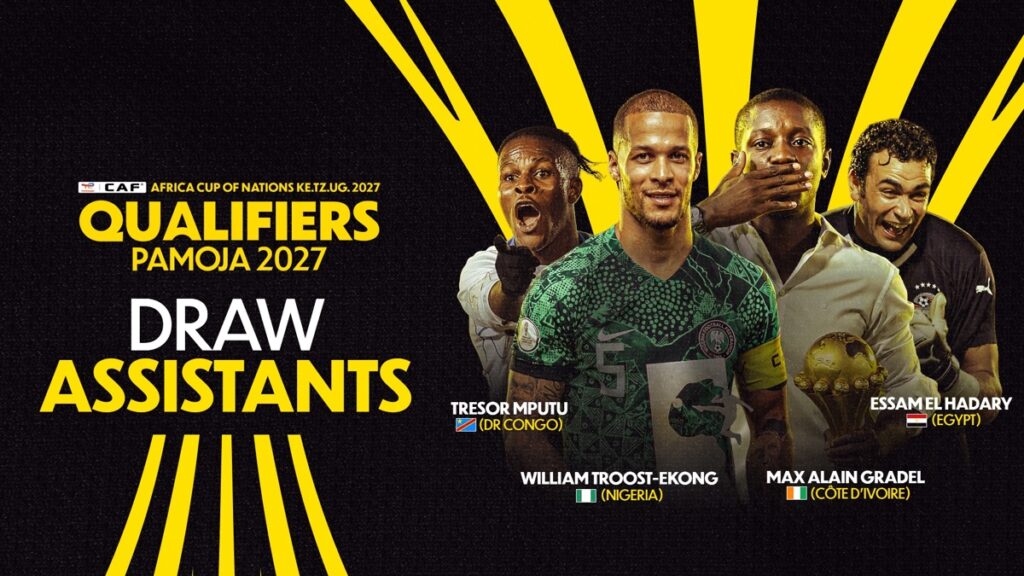
William Troost-Ekong has been selected by CAF as one of four African football legends who will assist with Tuesday’s AFCON 2027 qualification draw in Cairo, bringing Nigeria’s former captain into the ceremony for a tournament that will make history as the first Africa Cup of Nations co-hosted by three nations.
Event: AFCON 2027 Qualification Draw
Date: Tuesday, May 19, 2026 | Venue: Egyptian Football Association HQ, Cairo
Want our football coverage to show up first?
Add FootballInNigeria as a preferred source and our stories get a "Preferred" badge in your Google Top Stories, AI Overviews, and AI Mode results.
Draw format: 48 teams into 12 groups — top 2 from each group qualify
AFCON 2027 Finals: Kenya, Uganda, Tanzania | June 19 – July 17, 2027
Historic significance: First three-nation co-host | First East Africa AFCON in 51 years
Legends assisting draw: Troost-Ekong (Nigeria), Gradel (Ivory Coast), El Hadary (Egypt), Mputu (DR Congo)
William Troost-Ekong spent years as the man Nigeria’s defence organised itself around, captaining the Super Eagles through some of the most important qualifying campaigns and tournament appearances of the current generation. On Tuesday in Cairo, he takes on a different kind of representative role: one of four African football legends chosen by CAF to assist with the AFCON 2027 qualification draw at the headquarters of the Egyptian Football Association, a ceremony that launches the qualifying journey toward one of the most historically significant AFCON finals in the competition’s 64-year history.
The draw will determine the 12 groups into which the 48 qualifying nations are distributed, with the top two teams from each group advancing to the AFCON 2027 finals in East Africa next summer. Kenya, Uganda and Tanzania, the three co-hosts, will participate in the qualifiers but have their places in the finals already secured, meaning one team from whichever group each co-host is placed in will join them at the tournament regardless of their qualification finish.
Nigerian football fans following the AFCON 2027 draw and Super Eagles qualification campaign can use the Bet9ja AFCON qualification code to stay connected with all the national team news as the draw results and group assignments are announced on Tuesday.
The Four Legends Alongside Troost-Ekong
| Legend | Country | Career Highlights |
|---|---|---|
| William Troost-Ekong | Nigeria | Super Eagles captain | AFCON finalist | 78+ caps |
| Max-Alain Gradel | Ivory Coast | Premier League, Ligue 1 | AFCON 2015 winner |
| Essam El Hadary | Egypt | World’s oldest World Cup goalkeeper (2018) | 4× AFCON winner |
| Trésor Mputu | DR Congo | DR Congo legend | Multiple CAF Player of Year nominations |
The selection of Troost-Ekong places a Super Eagles representative at the ceremonial heart of a competition that Nigeria has won three times and consistently regards as one of the most important items on its football calendar. His presence alongside El Hadary — the most decorated goalkeeper in AFCON history with four continental titles — and Gradel, who won the 2015 AFCON with Ivory Coast on home soil, gives the draw ceremony a panel that spans the full breadth of African football’s recent continental history.
Why AFCON 2027 Is Historic On Multiple Levels
The 2027 Africa Cup of Nations carries a specific set of historical firsts that distinguish it from every previous edition of the tournament. Kenya, Uganda and Tanzania’s joint hosting is the first time in the competition’s 64-year history that three nations have shared the organisation of the continental championship. Previous AFCON editions have been hosted by one nation, with occasional late changes of host (most recently when Cameroon’s 2019 edition was moved and eventually delayed to 2021), but never by a three-country partnership of this kind.
The East African dimension adds another layer of historical significance. The last time AFCON was held in East Africa was in 1976, when Ethiopia hosted the tournament and Egypt won their fourth title. A 51-year absence from the region is one of the longer geographical gaps in the competition’s history, and the 2027 edition’s arrival in Kenya, Uganda and Tanzania represents both a commercial and a cultural landmark for football on that side of the continent. The Super Falcons have won WAFCON, the women’s equivalent, in recent years with strong East African competition providing some of their most challenging opponents. For the men’s tournament, East Africa’s growing football infrastructure makes 2027 a genuinely different environment from any previous AFCON.
Fans following Nigeria’s AFCON 2027 qualifying group assignment can check the Bet9ja YOHAIG qualification code for the best current registration offer ahead of Tuesday’s draw results.
Troost-Ekong’s Career And What His Selection Represents
William Troost-Ekong’s inclusion in the AFCON 2027 draw ceremony reflects CAF’s recognition of his standing not just as a former Super Eagles captain but as one of the defining figures of Nigerian football in the 2018-to-2026 era. Born in Dordrecht in the Netherlands to a Nigerian father, he committed to representing Nigeria after coming through Dutch youth football and went on to become one of the Super Eagles’ most consistent and vocal leaders across nearly a decade of international football.
His career saw him play for clubs across four countries including Gent, Bursaspor, Udinese, Watford, and several others across European football. At international level, he captained Nigeria to the 2019 AFCON third-place finish in Egypt and led the defence through multiple World Cup qualifying campaigns, accumulating more than 78 caps before gradually transitioning out of the squad as the current generation established itself under Eric Chelle’s management. His selection for Tuesday’s draw is a formal recognition of that legacy in the most public continental forum available.
The Qualifying Format And What It Means For Nigeria
The 48-team field being drawn on Tuesday will be distributed across 12 groups of four, with the top two teams from each group advancing to the AFCON 2027 finals alongside the co-hosts. Nigeria, as one of the continent’s most successful AFCON nations with three titles, will enter the draw as one of the higher-seeded sides. Their group assignment will determine whether the road to East Africa passes through straightforward qualification or requires the Super Eagles to navigate a more demanding set of opponents during the 2026-27 qualifying cycle.
For Eric Chelle’s side, the AFCON 2027 qualifying campaign runs parallel to the 2026 World Cup this summer and the various other competitions on the Nigerian football calendar. The draw on Tuesday will give the NFF and the Super Eagles’ coaching staff a clear picture of the matches scheduled across the qualification window, allowing for pre-planning that the World Cup’s own schedule will need to accommodate. As reported by FootballInNigeria.com.ng, Tuesday’s draw in Cairo is the formal beginning of Nigeria’s AFCON 2027 journey, with Troost-Ekong’s presence at the ceremony adding a Nigerian voice and face to one of continental football’s most important administrative moments. Fans following all the AFCON 2027 news can also use the Bet9ja jackpot prediction page for the latest offers as the qualification cycle begins.
📌 Did You Know?
- William Troost-Ekong was born on September 1, 1993, in Dordrecht, Netherlands, and came through the youth academy of Dutch club SBV Excelsior before beginning his senior career. He committed to representing Nigeria through his Nigerian father’s heritage and made his Super Eagles debut in 2015 under Sunday Oliseh’s management.
- Essam El Hadary, one of Troost-Ekong’s fellow legends at Tuesday’s draw, became the oldest goalkeeper ever to appear in a FIFA World Cup when he played for Egypt against Saudi Arabia in Russia in 2018, aged 45 years and 161 days. He is also the most decorated goalkeeper in AFCON history, having won the continental title four times with Egypt.
- Max-Alain Gradel, the Ivorian legend selected alongside Troost-Ekong, won the AFCON with Ivory Coast in 2015 on home soil. He played his club football primarily in France and the Premier League with Saint-Étienne and Bournemouth, becoming one of the more widely-known Ivorian footballers in European football during the 2010s.
- Trésor Mputu, the Congolese legend on the panel, is widely regarded as one of the greatest footballers DR Congo has ever produced. He spent almost his entire career at TP Mazembe, one of Africa’s most successful club sides, and was nominated for the CAF African Player of the Year award on multiple occasions during his peak years.
- The last time the Africa Cup of Nations was held in East Africa was the 1976 edition, won by Morocco, which was hosted by Ethiopia. Ethiopia was also the location of the very first AFCON in 1957, making it the birthplace of the competition, and its 2027 exclusion from the co-hosting arrangement reflects the shift in African football infrastructure over the subsequent half-century.
- Kenya’s inclusion as a co-host of AFCON 2027 is particularly significant given the country’s historically limited success in the continental tournament itself. The Harambee Stars have qualified for the AFCON finals only rarely across the competition’s history, making the hosting role a landmark moment for Kenyan football’s profile on the continental stage regardless of their on-pitch performance in the tournament.
- The 48-team format for AFCON 2027 qualifying, with 12 groups of four, means Nigeria’s path to East Africa involves three home matches and three away matches across the qualifying cycle. The group draw on Tuesday will determine which opponents the Super Eagles face, with the seeding system designed to ensure that the strongest nations are spread evenly across the 12 groups.