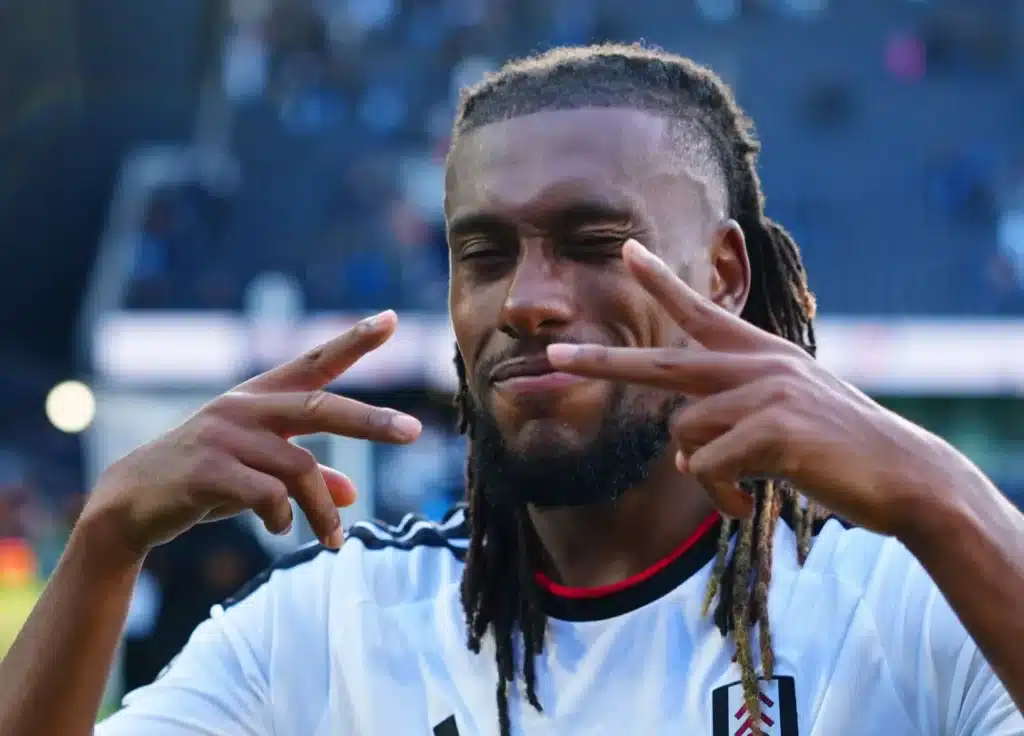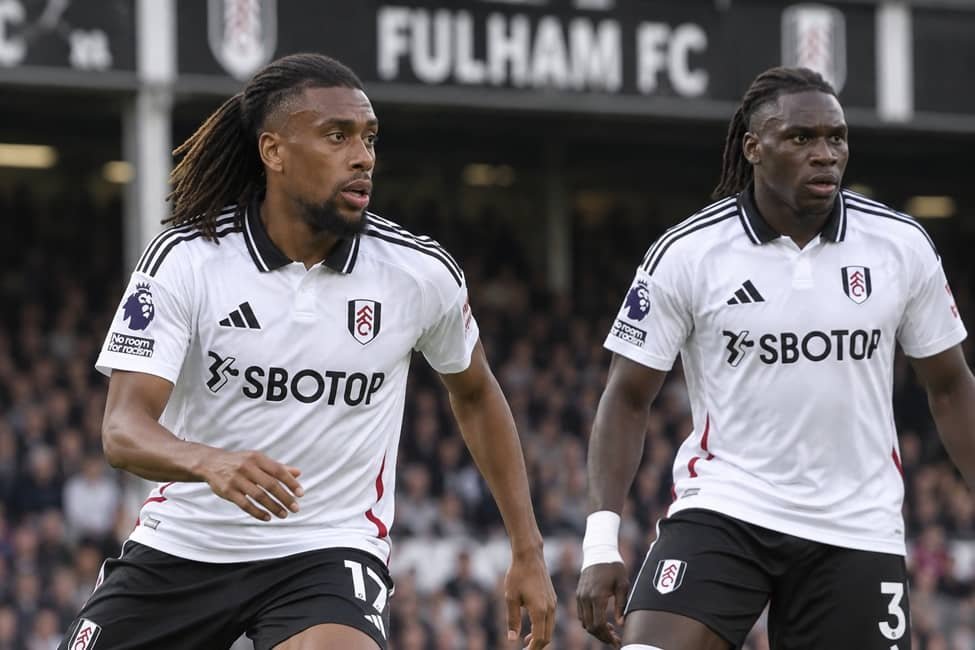

The best advice Alex Iwobi ever received was two words long. His uncle Jay-Jay Okocha didn’t just say them — he lived them, every day, from the dressing room to the Christmas table. Iwobi was watching the whole time.
There are players who receive great advice and quote it in interviews. And then there are players who receive great advice and actually absorb it into who they are. Alex Iwobi belongs to the second category. Speaking on The High Performance Podcast, he traced the footballing philosophy that has shaped his entire career back to a single source: his uncle, the incomparable Jay-Jay Okocha, and two words that Okocha didn’t so much preach as embody.
“Express yourself.” That was it. Simple, direct, and coming from the most joyfully expressive footballer Nigeria has ever produced, those two words carried the full weight of a career built on doing exactly that. Iwobi heard them. He watched them in practice. And then he spent the next decade trying to bring that same quality into his own football.
Want our football coverage to show up first?
Add FootballInNigeria as a preferred source and our stories get a "Preferred" badge in your Google Top Stories, AI Overviews, and AI Mode results.
The Scene at Bolton’s Training Ground
The story Iwobi tells to illustrate Okocha’s character is one of those images that stays with you. The young Alex was visiting his uncle at Bolton Wanderers’ training ground during Okocha’s time in England. Sam Allardyce, one of the most imposingly serious managers in Premier League history, was standing nearby. And there is Jay-Jay Okocha, unbothered, dancing, kicking the ball at his nephew in the middle of what is supposed to be a professional training environment.
Ivan Campo sees it. Kevin Nolan sees it. They call out Okocha’s name. He doesn’t care. He is, as Iwobi put it, “just in his own world.” And crucially, nobody stops him. Because this is Jay-Jay Okocha. The rules bend slightly when he’s in the room, not because he’s breaking them, but because his joy is so genuine and so complete that even Big Sam Allardyce can’t reasonably object.
— Alex Iwobi, The High Performance Podcast, 2026
That scene is more than a funny anecdote. It’s a portrait of what genuine self-expression looks like when it’s fully integrated into a personality. Okocha wasn’t performing joyfully. He wasn’t putting on a show for his nephew. He was simply being himself, completely and without apology, in an environment designed to impose professional discipline. That’s a hard thing to do. Most people can’t manage it at a professional football club in 2003. Okocha made it look effortless.
Okocha: The Man Behind the Lesson
Nigeria Legend
Jay-Jay Okocha is, by any reasonable assessment, the most gifted footballer Nigeria has ever produced. At Paris Saint-Germain, Fenerbahce, Bolton Wanderers, and throughout his Super Eagles career, he played with a level of technical brilliance and creative audacity that put him in the conversation with the best attacking midfielders of his generation. The Bolton years, which came late in his career, were still spectacular enough that the Trotters fans adopted the chant “Jay-Jay Okocha, so good they named him twice” as a permanent part of their repertoire.
He won the 1994 AFCON with Nigeria in Tunisia, a tournament in which Nigeria announced themselves to African football as a new dominant force under the management of Clemens Westerhof. He captained the Super Eagles for years. He was, for an entire generation of Nigerian football fans, the reason people stayed up late to watch Premiership highlights packages.
For Iwobi, growing up with this man as his uncle wasn’t just a fortunate family circumstance. It was a football education conducted in living rooms, training grounds, and Christmas gatherings across two continents. He didn’t study Okocha on YouTube. He sat at the same table as him. He watched him at work. He received the advice directly, from the source, and then spent years watching the source prove that the advice worked.
Christmas Gatherings and the Definition of Joy
Iwobi’s other memory of his uncle is equally telling. Back home during the Christmas period, Okocha was dancing. Not performing for anyone. Not conscious of an audience. Just dancing because that is what he does, what he has always done, what no career and no manager and no amount of professional pressure has ever managed to squeeze out of him.
— Alex Iwobi, The High Performance Podcast, 2026
That detail matters. It’s easy for a footballer to say “express yourself” as a piece of advice. It’s harder to live that way over a 15-year career, through difficult seasons, bad managers, positional frustrations, and public criticism. Okocha did it. He was the same person in every environment Iwobi saw him in. The training ground. The family gathering. The Premier League. He brought the same energy, the same spirit, the same fundamental commitment to playing and living with joy, everywhere.
How the Advice Shaped Iwobi’s Career
Look at the arc of Iwobi’s career, and you can see Okocha’s influence threading through it. The most frustrating phases of his development came when he was trying to be something he wasn’t: a disciplined wide midfielder grinding out defensive duties, a positional workhorse suppressing the creative instincts that made him worth £34 million to Everton in the first place.
The best phases, the Arsenal breakout under Wenger, the early Fulham years under Marco Silva, and his current form that earned him a Goal of the Month nomination this very week, have come when Iwobi trusted himself to express what he actually sees on the pitch. That 85th-minute finish against Sunderland, calm and composed into the corner? That’s not the product of fear. That’s what playing without fear looks like.
As FootballInNigeria.com.ng covered earlier this week, Iwobi also opened up about how a social media post about his preferred position at Everton cost him his place under Carlo Ancelotti in 2021. He called it “childish.” What the Ancelotti episode and the Okocha story together tell us is that Iwobi’s journey has been about learning which kind of freedom actually serves him: not the freedom to air grievances publicly, but the deeper freedom Okocha modelled, the freedom to play without anxiety, to be yourself completely within the game.
Editorial: What Okocha’s Legacy Means for Nigerian Football
The greatest players don’t just leave behind statistics and trophies. They leave behind a way of playing, a philosophy that gets transmitted through families, academies, and training-ground stories. Jay-Jay Okocha never managed a senior team. He never wrote a coaching manual. But his nephew is playing some of the best football of his career at 29, and he attributes the foundation of his approach directly to watching his uncle live.
That’s how the best football legacies work. Not through formal institutions, but through direct transmission: a dance at a training ground, two words at the right moment, a Christmas gathering where a former Super Eagles captain is just being fully, irrepressibly himself. Nigerian football has produced many great players. But it has produced very few who embodied the joy of the game as completely as Okocha did. That Iwobi carries some of that forward, consciously and explicitly, is one of the more beautiful stories in Nigerian football right now.
Express yourself. Two words. A whole career’s worth of meaning.
With Iwobi in this kind of form and mindset, Nigerian football fans following his Fulham run can back his continued contributions through the Bet9ja promotion code — offering up to ₦100,000 on first deposit and 170% boosts on football accumulators. A player playing with this kind of freedom and confidence is exactly the kind of performer worth building multi-leg wagers around.
What He’s Passing On
Iwobi is 29 now. He’s at the point in his career where he becomes the senior player in dressing rooms, the one younger players look to for how a professional carries himself. The advice Okocha gave him, those two words and a lifetime of demonstration, will pass from Iwobi to whoever is watching him next.
That’s how it works. That’s how Jay-Jay Okocha is still teaching, still influencing, still dancing at Christmas, still in his own world on the training ground, still producing footballers who play with a smile on their face.
📌 Did You Know?
- Jay-Jay Okocha’s full name is Augustine Azuka Okocha. His nickname “Jay-Jay” has been used since his earliest playing days in Nigeria and became one of the most recognisable football nicknames in the world during his years at Bolton Wanderers.
- Bolton Wanderers paid Paris Saint-Germain a then-significant fee for Okocha in 2002, and he went on to become so beloved at the Reebok Stadium that Bolton fans voted him their Player of the Year in back-to-back seasons, 2003 and 2004.
- Okocha’s famous goal against Oliver Kahn and Bayern Munich in the 1993 UEFA Cup, where he dribbled past the goalkeeper and several defenders before finishing, is widely considered one of the greatest individual goals in European football and established him as a global talent at just 19 years old.
- Sam Allardyce, the Bolton manager in whose presence Okocha was observed dancing by the young Iwobi, has repeatedly cited Okocha as one of the most gifted players he ever managed, despite Allardyce’s reputation for preferring a more direct, physical style of football.
- Ivan Campo, one of the Bolton teammates who called out to Okocha in Iwobi’s story, was a Spanish international defender who won the UEFA Champions League with Real Madrid in 2000 before joining Bolton, making Okocha’s casual disregard for the professional setting even more striking given the calibre of company around him.
- Iwobi was nominated for Fulham’s February 2026 Goal of the Month this same week for his composed finish against Sunderland at the Stadium of Light — the same Iwobi who watched Okocha dance at Bolton’s training ground as a child is now producing moments worthy of individual recognition in the Premier League at 29.
- Nigeria’s 1994 AFCON-winning squad, which included Okocha, is widely regarded as one of the greatest Super Eagles generations in history, also featuring players like Rashidi Yekini, Emmanuel Amuneke, and Finidi George — a golden generation whose influence on Nigerian football culture is still felt today.