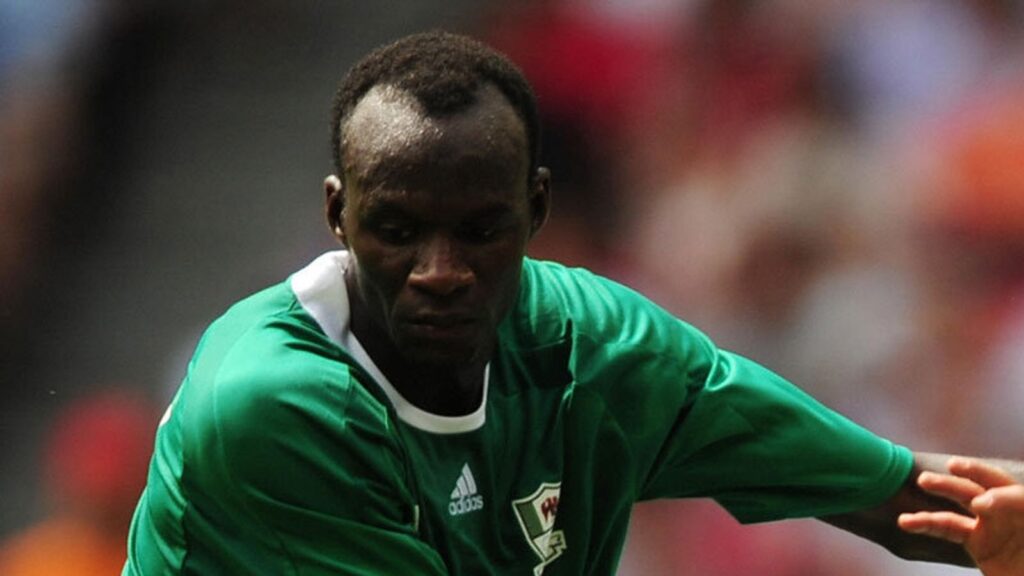
The former Super Eagles midfielder has formally submitted his application to the NFF, citing his UEFA B License and years of youth coaching experience in the UK as the foundation for a role he believes he was built for.
Sani Kaita wants back in. The 38-year-old former Super Eagles midfielder has formally applied for the vacant head coach position of Nigeria’s U-17 national team, the Golden Eaglets, after the Nigeria Football Federation opened applications across several youth team roles in February 2026.
Kaita, now based in the United Kingdom, hasn’t just lobbed his name into the ring. He’s been building quietly and deliberately toward a moment like this, earning his UEFA B License through the Football Association of Wales and gaining hands-on experience within the UK youth development system at Hellenic FC. He says he’s ready. And his application argues he has the credentials to back that confidence.
What Kaita Is Bringing to the Table
His playing CV speaks for itself. Kaita represented Nigeria at the 2005 FIFA U-20 World Cup in the Netherlands, where he won a silver medal. Three years later, he was part of the Super Eagles squad that won silver at the 2008 Beijing Olympics. He then reached the pinnacle as a senior international, appearing at the 2010 FIFA World Cup in South Africa.
His club career took him across Europe with purpose. He played for Sparta Rotterdam in the Netherlands, AS Monaco in France, and had stints across Russia and Greece. That breadth of experience across multiple football cultures is exactly what youth development coaches need: the ability to draw from different systems, different styles of play, and different approaches to nurturing young talent.
Since hanging up his boots, Kaita earned his UEFA B License in April 2025, a qualification he obtained through the FA of Wales. He’s been applying that badge in practical settings, working with young players at Hellenic FC in the UK youth football structure.
In His Own Words
Kaita didn’t just apply quietly. He publicly confirmed his interest and outlined his vision for the role.
— Sani Kaita
He went further, addressing the specific work he’s put in to prepare for a coaching career.
— Sani Kaita
The phrase “virile and winning team” is what he used when describing his ambition for the Golden Eaglets. That’s language with intent behind it. Kaita isn’t applying to tick a box. He wants this job.
The Golden Eaglets Need a Reset
The timing of Kaita’s application matters. The Golden Eaglets are Nigeria’s most decorated youth football team and the most successful nation in FIFA U-17 World Cup history with five titles, the first coming at the inaugural tournament in 1985. But the programme has fallen on hard times. Nigeria missed the FIFA U-17 World Cup for the third consecutive time in 2025, a staggering decline for a team that once defined the tournament.
That’s the challenge facing whoever the NFF appoints. It’s not just about coaching technique. It’s about rebuilding an identity, restoring a pipeline, and reconnecting Nigeria’s grassroots football ecosystem to the national youth setup in a way that consistently produces tournament-ready players. Whoever gets the job inherits both a proud legacy and a programme urgently in need of structural repair.
Kaita isn’t the only candidate. Remo Stars coach Daniel Ogunmodede has also expressed interest in youth team coaching roles advertised in the same NFF vacancy cycle, applying for the Flying Eagles (U-20) position. The NFF’s Technical Committee will assess several applications across multiple age-group roles.
Analysis: Is Kaita the Right Man for the Eaglets?
The case for Kaita is genuine. He played youth football at the highest level for Nigeria and won medals. He’s been educated within a rigorous European coaching framework. He’s actively working with youth players right now, not just theorising about it from a distance. These are the foundations the NFF should want in a Golden Eaglets coach.
The case for caution is also real. A UEFA B License is a solid entry-level coaching qualification, but it’s not the highest available. The Golden Eaglets’ role ideally requires someone with a UEFA A License or its CAF equivalent, given the complexity of managing an international youth squad through continental qualifying and a World Cup campaign. Kaita should be actively pursuing that upgrade. Whether the NFF will consider a B License sufficient for this particular appointment remains to be seen.
There’s also the elephant in the room. Kaita’s name in Nigerian football carries baggage. His red card against Greece at the 2010 World Cup, which effectively ended Nigeria’s tournament, isn’t something that disappears from public memory. It shouldn’t define a coaching career. But Kaita will need to demonstrate clearly that his coaching identity is built on the discipline and focus that his playing career sometimes lacked under pressure.
The potential is there. The credentials are developing. If the NFF wants a Nigerian who has lived in European football from the inside and is genuinely passionate about giving something back through youth development, Kaita deserves serious consideration. But the appointment, if it comes, needs to come with proper support structures around him.
What Comes Next
The NFF’s Technical Committee is expected to review all applications before making appointments across the youth team positions. There’s no confirmed timeline yet for when decisions will be announced, but with qualifying cycles for the next round of African youth championships approaching, the federation will want to move quickly.
For Kaita, this application is more than a job pitch. It’s a statement of purpose. He’s spent years preparing for this moment in relative quiet, earning qualifications, building experience, and staying close to the game he loves. Whether the NFF rewards that commitment is now their decision.
The Golden Eaglets deserve a coach who will bleed for that badge. Everything Kaita has said publicly suggests he would. Nigeria’s next generation of talent is waiting for someone to build around them. For fans who back Nigeria’s youth development journey, the Bet9ja YOHAIG code gives you access to up to ₦100,000 on first deposit to back Nigerian football across all age groups and competitions.
📌 Did You Know?
- Sani Kaita became the first Nigerian player to receive a red card at a FIFA World Cup, when he was dismissed in the 33rd minute against Greece at the 2010 tournament in South Africa after kicking out at Vassilis Torosidis.
- Nigeria’s Golden Eaglets are the most successful nation in FIFA U-17 World Cup history, having won the tournament five times: 1985, 1993, 2007, 2013, and 2015. No other country has won it more than twice.
- The Golden Eaglets’ last FIFA U-17 World Cup title in 2015 was powered by Victor Osimhen, who won the Golden Boot with 10 goals across the tournament in Chile, a record at that edition of the competition.
- Nigeria has missed the FIFA U-17 World Cup three consecutive times as of 2025, a dramatic fall from grace for a programme that once dominated the tournament and defined African youth football globally.
- Kaita won a silver medal at the 2008 Beijing Olympics with the Super Eagles, a squad that also included players like Nwankwo Kanu, John Obi Mikel, and Obafemi Martins, finishing runners-up to Argentina in the final.
- Kaita earned his UEFA B License through the Football Association of Wales in April 2025, having chosen the Welsh FA pathway for his coaching education after relocating to the United Kingdom following his playing retirement.
- The NFF’s February 2026 coaching vacancy announcement covered four separate youth and women’s national team positions simultaneously: the Olympic Eagles (U-23), Flying Eagles (U-20), Golden Eaglets (U-17), and Flamingos (U-20 women).