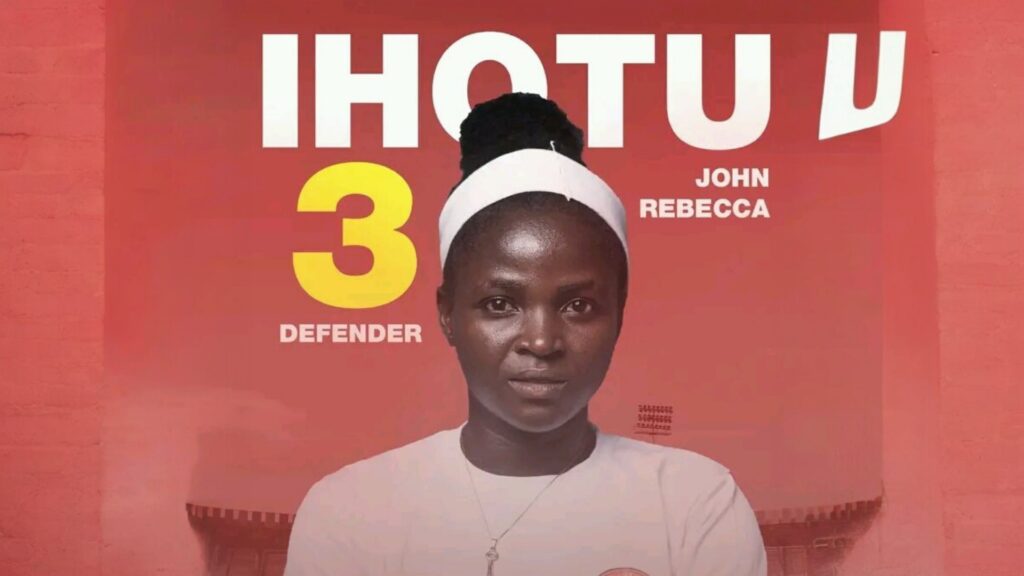
She’s out. Ihotu John Rebecca, the NWFL Premiership footballer abducted along the Benin Expressway on February 27, has been freed. Her family paid ₦1.5 million to secure her release late Thursday night — a fraction of the ₦20 million originally demanded, but an amount that no family of a Nigerian women’s footballer should ever have had to find.
She Is Out
The news came through a phone call. Blessing Ojima, a relative of Ihotu John Rebecca, confirmed to the Foundation for Investigative Journalism on Friday morning that Rebecca had been freed. Ojima said she hadn’t yet seen her in person but had spoken with her directly by phone.
“She is out. We paid N1.5 million,” Ojima said.
Those five words carry more weight than any statement from any institution that stayed silent while this family scrambled, in terror, for eight days. Rebecca was taken on 27 February 2026 in Okada, Edo State, along with two other passengers in the same vehicle. She was released late on the night of Thursday, 5 March. She had been in captivity for seven days.
How the Ransom Was Paid
The account Ojima gave to FIJ of how the ransom was actually transferred is a window into just how dangerous, chaotic, and deeply human these situations are. It wasn’t a clean transaction. It was terrifying, improvised, and dependent entirely on trust built between strangers across WhatsApp calls and Point of Sale terminals.
“The father called and said the kidnappers sent my number to him so we can discuss how the ransom money would reach them. They wanted cash, not a transfer. We used more than seven Point of Sale (PoS) terminals in Benue to transfer the money to this man, who then withdrew and handed it over to the kidnappers.
“I was even afraid at first because I didn’t know him. I first sent N200,000, and the man called me to confirm that he had received it. When he did this, I was a bit relieved that he could be trusted. And that’s how he confirmed each transfer.”
— Blessing Ojima, relative of Ihotu John Rebecca, speaking to FIJ on 6 March 2026
Seven PoS terminals. Cash only. A stranger on the phone. The entire ransom process rested on a father in Benue acting as an intermediary between terrified families and armed kidnappers. No coordination with the Nigerian Police Force was described here. No NFF emergency fund. No NWFL support mechanism. Just a family figuring it out, alone, under enormous pressure, and praying the stranger on the other end of the line could be trusted.
Around midnight on Thursday, the intermediary called to confirm that Rebecca and the others had been released. By 5am on Friday, Ojima called back. They were in Ore, heading toward Onitsha. Rebecca was alive. She was moving. She was free.
The Full Picture of What Happened
Rebecca was abducted on 27 February 2026 — not 1 March, as initially reported by some outlets when the story broke publicly. The abduction took place in Okada, Edo State, when armed kidnappers ambushed the vehicle she was travelling in. Two other passengers were taken with her: a woman and a boy, described as under 18.
The kidnappers initially demanded ₦20 million in ransom. When the family couldn’t meet that figure, the demand was reduced to ₦10 million, with a 24-hour ultimatum issued on 3 March. After further negotiation, the final amount paid was ₦1.5 million, distributed across seven PoS transactions to the father of a fellow kidnapping victim who acted as the cash courier.
- 27 February 2026: Rebecca abducted in Okada, Edo State, along with two other passengers
- 1 March 2026: Story breaks publicly on social media; FootballInNigeria.com.ng publishes breaking report; ₦20m ransom demand confirmed
- 3 March 2026: Kidnappers reduce demand to ₦10 million and issue 24-hour ultimatum
- 4-5 March 2026: Family negotiates further; ransom settled at ₦1.5 million
- 5 March 2026 (midnight): Rebecca released to intermediary father in Edo
- 6 March 2026 (morning): Family confirms release; Rebecca travelling from Ore toward Onitsha
- Official response from NFF, NWFL, Pacesetter Queens, or Police: None confirmed
Relief Tempered by Hard Truths
Rebecca is free. That is the only thing that matters on this Friday morning, and the Nigerian football community is right to exhale. But the relief has to live alongside an honest accounting of what this episode revealed about the conditions Nigerian women footballers operate in.
Her family scrambled for days without any confirmed support from the institutions that govern her sport. The NWFL issued no public statement. Pacesetter Queens FC issued no public statement. The NFF issued no public statement. The Nigeria Police Force confirmed no formal investigation publicly, and the family’s own account of the ransom payment describes a process entirely outside any formal law enforcement framework.
The kidnappers initially demanded ₦20 million from a family that clearly didn’t have it. They negotiated down to ₦10 million, then accepted ₦1.5 million. That negotiation happened through fear, improvisation, and the kindness of a stranger who agreed to act as a go-between. None of it should have fallen on them to manage alone.
Comment: The Relief Is Real. The Problem Is Not Solved.
Ihotu John Rebecca is free. Her family found the money, built trust with a stranger in Benue, and brought her home. That is an outcome worth celebrating. But it is also an outcome that occurred entirely without the infrastructure that should support it.
No player welfare fund was activated. No federation emergency protocol was triggered. No club security liaison stepped in. The Nigerian women’s football ecosystem, in the midst of a genuine crisis involving one of its own, was absent. The family did everything themselves.
That has to change. The NFF, NWFL, and individual clubs must now answer the hard questions that Rebecca’s ordeal makes unavoidable: Is there an emergency welfare fund for players in crisis? Are there security protocols for intercity travel? Is there a formal relationship with the Nigerian Police Force for situations exactly like this? If the answers are no — and they almost certainly are — then the lesson of this week isn’t just that Rebecca was lucky. It’s that every player in the NWFL is one unsafe journey away from the same nightmare, with the same absence of institutional support waiting for them on the other side.
A Week Nigerian Football Should Not Forget
There are three people who were abducted in that vehicle on 27 February in Okada. Rebecca is free. The other woman and the boy, described as under 18, are also reported to have been released as part of the same transaction — all three freed through the same midnight phone call, the same PoS chain across seven terminals in Benue, the same stranger’s willingness to act honourably in an impossible situation.
Their names haven’t circulated as widely as Rebecca’s. That’s partly because she’s a footballer and her story found a ready-made audience in the Nigerian football community. But their ordeal was the same. Their families went through the same terror. They deserve the same relief.
FootballInNigeria.com.ng will continue to follow this story. The immediate crisis is over. The structural failures that created it are not. We will be watching for the official responses, now overdue, from the NFF, NWFL, and the Nigeria Police Force, and we will report on them when they come — or on their continued absence if they don’t.
Ihotu John Rebecca is home. That is what matters today. The rest of the work starts tomorrow.
📌 Context: What This Case Reveals
- The ₦1.5 million finally paid represents just 7.5% of the original ₦20 million demand — illustrating how dramatically kidnappers can reduce their demands when families have no realistic ability to pay the opening figure, and when time and pressure work against the abductors too.
- The ransom was transferred using more than seven separate PoS terminals across Benue State — a method designed to avoid bank transfer records and make the payment harder to trace. This is a common technique used by criminal kidnapping networks operating in southern and central Nigeria.
- Rebecca was abducted on 27 February — five days before the story broke widely on social media on 1 March. That five-day gap, during which no official alert was issued by any football body, reflects how isolated NWFL players and their families can be when crises occur during travel.
- The intermediary who facilitated the ransom transfer was the father of another kidnapping victim taken in the same vehicle — a man who was simultaneously managing his own family’s ransom while serving as the go-between for Rebecca’s family. His cooperation was entirely voluntary and informal.
- The Okada area of Edo State, where the abduction took place, sits along one of Nigeria’s busiest intercity road corridors. It has been the site of multiple armed kidnappings in the past three years, with criminal networks operating from surrounding bush areas targeting commercial vehicles.
- Pacesetter Queens FC, the NWFL Premiership club Rebecca plays for, was only promoted to the top flight in October 2025 — meaning this incident occurred during the club’s very first season in Nigerian women’s top-flight football.
- The three victims — Rebecca, the other woman, and a boy described as under 18 — were all released together as part of a single negotiated transaction, suggesting the kidnappers treated them as a collective bargaining unit rather than individual targets with separate ransom demands.