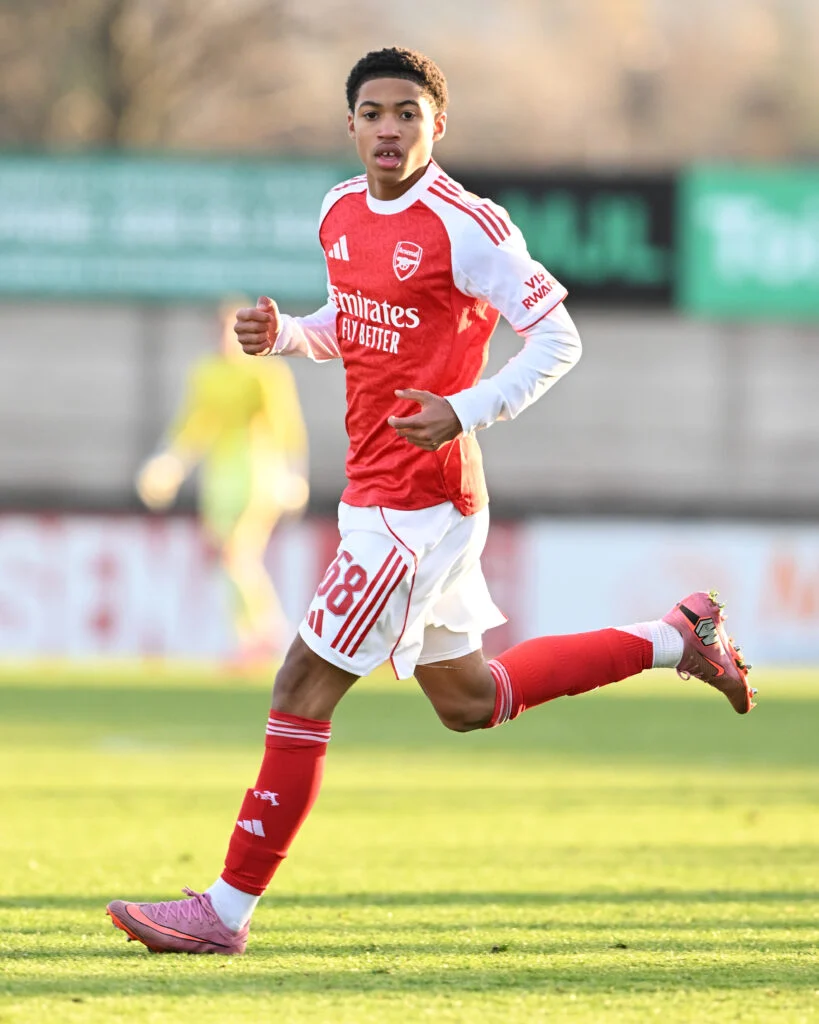
On Friday morning at London Colney, Mikel Arteta brought three teenagers of Nigerian descent into Arsenal’s first-team session ahead of Saturday’s FA Cup fifth-round tie with Mansfield Town. The Nwaneri family, Nigerian-heritage talent, and the Arsenal academy are once again producing a story the NFF needs to be watching closely.
Final year
Scholar intake 2026-27
Final year
Scholar intake 2026-27
Development squad
Regular first-team trainee
The Three Players: Who They Are
Emerson Nwaneri carries the most loaded context of the three. His older brother, Ethan Nwaneri, became the youngest player ever to appear in the Premier League when he made his debut at 15 years and 181 days old for Arsenal against Brentford in September 2022. That record cannot be broken by Emerson, who was 15 years and 201 days old on Friday, already beyond the threshold. Both brothers share Nigerian heritage and have trained in elite football environments since childhood. The Nigeria Football Federation (NFF) has tracked Ethan’s eligibility to play for Nigeria’s national teams, reflecting its intention to ensure the most promising diaspora talent maintains active connections with the country’s squads. Emerson’s recent first-team training raises questions about whether the NFF is equally proactive with emerging young players like him, underscoring the importance of timely engagement in national recruitment strategies. Mishel Nduka is a schoolboy player of Nigerian descent, also at the end of his first schoolboy deal with Arsenal. Both Nduka and Emerson Nwaneri are expected to sign their first professional scholar contracts this summer, transitioning from schoolboy to academy professional status. This signing often prompts clubs and national federations, such as Nigeria’s NFF, to formally pursue players for international eligibility, since this is a critical stage for securing new national team prospects.Andre Harriman-Annous is the most senior of the three within the Arsenal setup. He plays primarily for the development squad but has earned four senior call-ups this season: against Slavia Prague in the UEFA Champions League, against Liverpool and Sunderland in the Premier League, and against Brighton in the Carabao Cup. Those call-up appearances, even without match minutes, indicate that Arteta sees Harriman-Annous as a player with genuine first-team potential rather than just a training-day filler.
Arsenal’s Mansfield FA Cup tie on Saturday, for which this training session was preparation, is not directly relevant to these three players’ development paths. None of them is expected to feature against League One opposition. The significance of the session lies in what it signals: Arteta is comfortable exposing young Nigerian-heritage players to the standards of his first-team environment at key moments in the season, and the club is clearly investing in this pipeline.
Observation of that pipeline is not the same as engagement with it. The NFF needs a dedicated diaspora recruitment infrastructure, a person or team whose sole responsibility is tracking these players, building relationships with their families, and making formal contact before England youth teams do. Once a player represents England at any youth level, the door closes permanently. Friday’s session at London Colney featured players who are still eligible to represent Nigeria. That eligibility will not last forever.
The Tomori precedent, as covered on FootballInNigeria.com.ng this week, is the cautionary tale. The Alhassan Yusuf story is an example of what happens when the approach is made and a player chooses to play for Nigeria. There are currently enough Nigerian-heritage players in English football academies to build a competitive squad. The question is whether the NFF will reach them before someone else does.
- Ethan Nwaneri made his Premier League debut for Arsenal against Brentford on September 18, 2022, at the age of 15 years and 181 days. His appearance as a substitute in that match made him the youngest player in Premier League history, breaking a record that had stood since 2003.
- Arsenal’s Hale End Academy, based in Walthamstow, east London, is one of the most productive youth development centres in English football. Notable graduates include Jack Wilshere, Ashley Cole, Cesc Fabregas, Bukayo Saka, and Emile Smith Rowe, with the pipeline now extending into a strong representation of Nigerian-heritage talent.
- Mishel Nduka, one of the three players who trained with the Arsenal first team on Friday, shares a surname with the former Nigeria international midfielder Anthony Nduka, though there is no publicly confirmed familial connection between the two. The name Nduka is a common Igbo surname meaning “life is supreme.”
- Arsenal’s FA Cup fifth-round tie against Mansfield Town on Saturday represents a significant test of squad depth for Mikel Arteta. Mansfield are a League One club but have reached the FA Cup fifth round for the first time in their history, making it one of the most significant matches in the Nottinghamshire club’s 139-year existence.
- The practice of promoting academy players to first-team training sessions on the eve of matches is a common method used by top European managers to assess potential and give young players a taste of senior environments. Arteta has been particularly consistent in this approach, having previously promoted players such as Bukayo Saka and Martin Odegaard to the first team before they became established regulars.
- Andre Harriman-Annous’s four senior call-ups this season, covering Champions League, Premier League, and Carabao Cup fixtures, represent more senior squad inclusions than many players achieve across multiple seasons in academy football. The variety of competitions he has been called up for suggests Arteta rates him highly as a prospect, rather than including him purely as a training-day addition.
- Jeorge Bird, the Arsenal youth team journalist who first confirmed Friday’s first-team training session, is one of the most closely followed Arsenal academy reporters and has been credited with breaking several significant stories about the club’s youth players in recent seasons. His reporting on these sessions is generally considered highly reliable by Arsenal supporters and journalists covering the academy.

