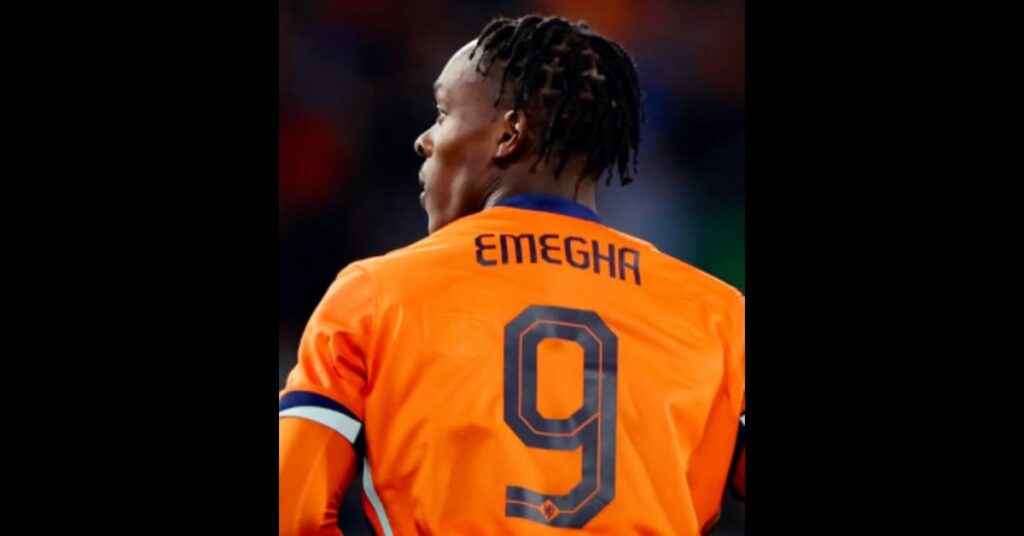
Dutch‑Nigerian forward Emanuel Emegha, who is set to join Chelsea, has made his senior debut for the Netherlands — a decision that means he is no longer eligible to represent the Super Eagles.
At 22, Emegha has committed his international future to the Dutch side after being called up for a 2026 World Cup qualifier against Poland, entering the match in the 87th minute.
Prior to that, he had featured at youth levels for the Netherlands (U15, U19, U21), even as Nigeria showed interest in recruiting him for the national team.
Emegha has publicly stated that although the Nigeria Football Federation reached out, his mind was already made up to continue with the Oranje.
This is the latest in a string of dual‑nationals choosing European sides over Nigeria, following other high‑profile picks like Joshua Zirkzee and Arnaut Danjuma illustrating the ongoing competition for talent between Nigeria and its diaspora.
Meanwhile, Nigeria has seen success in recruiting some players of dual nationality, especially in defence, with names like William Troost-Ekong and Tyronne Ebuehi having committed to the Super Eagles.
Editorial
The news that Emanuel Emegha has chosen the Netherlands over Nigeria, just as his move to Chelsea looms, is far more than a personal choice it is a quiet indictment of structure, strategy, and identity in Nigerian football.
At 22, Emegha is embarking on what should be a crowning chapter. His talent has been evident for years, and his trajectory towards Chelsea was always going to attract attention. But in this moment of career growth, he made a decision that sends a message for some Nigerian‑eligible talents, the pathway to the Super Eagles no longer feels compelling enough.
This is not merely about caps and allegiances. It’s about the architecture behind those decisions. European federations have established, professional pipelines. Their football associations invest in youth development, leverage their diaspora, and perhaps most importantly present a clear roadmap to tournament football. Nigeria, for all its raw talent, continues to wrestle with gaps in planning, outreach, and retention.
The irony is that Nigeria has had successes in securing dual‑nationals Troost‑Ekong, Ebuehi, and a few others stand as proof that the battle can be won. But the loss of a young striker like Emegha one on the cusp of a major Premier League move — is a reminder that potential alone is not enough.
This should prompt the NFF and its partners to reflect. Talent will not automatically choose Nigeria it must be created, courted, and convinced. Opportunities must be matched with vision. Because when the football world knocks, standing still is no longer an option.
Emegha’s decision is sobering. But if Nigeria is serious about reclaiming its rightful place as a global football power, then this moment should be more than a defeat. It must be a turning point.
Did You Know?
- Emegha’s Background: Emanuel Emegha was born in the Netherlands to a Nigerian father and a Togolese mother, making him eligible for multiple national teams.
- Chelsea Move Confirmed Although his Chelsea transfer is widely reported, Emegha’s move is still in the works and was described as “agreed” but not yet officially completed.
- Dual-National Trend Nigeria has lost multiple young forwards to other national teams in recent years, including Joshua Zirkzee (Netherlands) and Arnaut Danjuma (Netherlands via Valencia).
- Cap-Tying Rule Impact By appearing for the Netherlands in a competitive senior match, Emegha is now cap-tied and cannot switch to another national side under FIFA rules.
- NFF Strategy Questioned Experts have criticized the Nigeria Football Federation for lacking a sustained long-term strategy to engage dual-nationals from youth levels something that European FA’s often handle more systematically.

