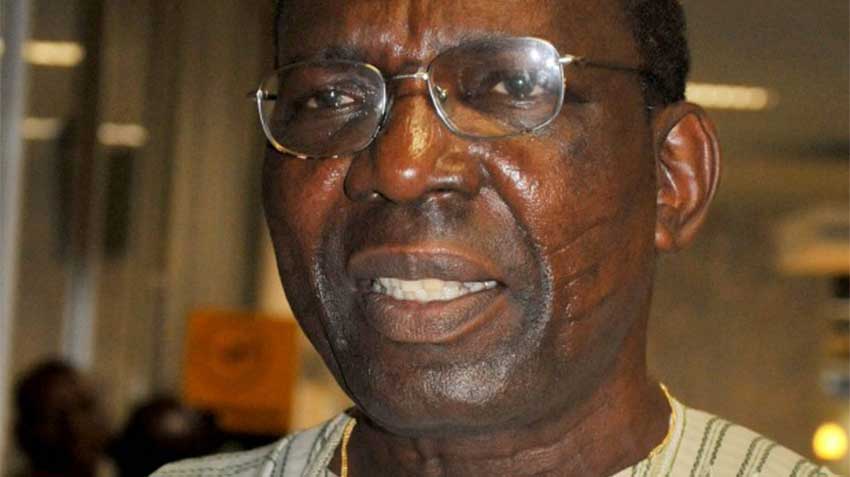
High Chief Festus Adegboye Onigbinde, a towering figure in Nigerian football who made history as the country’s first indigenous coach at a FIFA World Cup, passed away on Monday, March 9, 2026. He was 88 years old.
A Pioneer Is Gone
Nigerian football lost one of its most important voices on Monday night. Adegboye Onigbinde, the man who broke barriers as Nigeria’s first indigenous head coach at a FIFA World Cup, died on March 9, 2026, at the age of 88. His family confirmed the news in a statement signed by Mrs. Bolade Adesuyi, describing him as “a great man, a community leader, and a football icon.”
“With great gratitude to God for a life well spent, we announce the passing of this great man… High Chief Festus Adegboye Onigbinde,” the family’s statement read. Details of his funeral arrangements were not immediately disclosed.
His death marks the end of an era. In a country that has long debated the place of indigenous coaches in its football system, Onigbinde was the clearest answer to that argument. He didn’t just make the case with words. He made it on the biggest stages in world football.
The Man Who Proved Nigeria Didn’t Always Need a Foreign Coach
Born on March 5, 1938, in Modakeke, Osun State, Onigbinde grew up to become one of Nigeria’s most decorated football administrators and tacticians. He had two separate stints as head coach of the Super Eagles, first from 1981 to 1984 and then again in 2002, making him one of the very few coaches in Nigerian football history to hold the job twice.
His first tenure produced arguably his finest achievement as a national team coach. He guided the then-Green Eagles to the 1984 Africa Cup of Nations final in Cote d’Ivoire, where they faced Cameroon. Nigeria lost 3-1 in that final, but the journey to that stage confirmed Onigbinde as a coach of genuine quality. That same year, he moved to Shooting Stars Sports Club in Ibadan and took the Oluyole Warriors all the way to the final of the Africa Club Champions Cup, where they narrowly fell to Zamalek of Egypt.
He wasn’t just winning matches. He was building a template for what Nigerian coaching could look like.
2002: History at the World Cup, Heartbreak in Korea-Japan
When Shuaibu Amodu was sacked following Nigeria’s disappointing exit at the 2002 Africa Cup of Nations, the NFF turned to Onigbinde. What he did next wrote him permanently into Nigerian football history. He became the first indigenous Nigerian coach to lead the Super Eagles to the FIFA World Cup, taking the team to the 2002 edition co-hosted by South Korea and Japan.
It wasn’t a tournament that went well on the pitch. Nigeria lost their opener 1-0 to Argentina, courtesy of a Gabriel Batistuta goal. They then surrendered a 1-0 lead to lose 2-1 to Sweden in their second group game, which ended their chances of progression. The tournament finished with a goalless draw against England. For the first time in Nigeria’s World Cup history, the team didn’t win a single match.
The criticism that followed was fierce. Players like Jay-Jay Okocha and Julius Aghahowa publicly questioned some of his squad selections. It was a difficult end to what had been, by any measure, a historic appointment. But the historians will always note what others sometimes forget: Onigbinde inherited a squad in turmoil, built largely around young and inexperienced players, and still got them to Japan and Korea.
More Than a Coach
Onigbinde’s legacy extends well beyond his time on the touchline. He served as a technical instructor for both CAF (the Confederation of African Football) and FIFA, mentoring coaches and contributing to football development across the African continent. His advocacy for indigenous coaching wasn’t theoretical. He lived it, and then taught it to others.
As FootballInNigeria.com.ng has consistently documented over the years, Nigerian football’s reliance on foreign coaches has always been a contentious topic. Onigbinde was the original counterargument. He believed passionately that Nigerians could coach Nigerians to greatness, and he spent decades backing that belief with action.
He was also a Modakeke High Chief, a respected community leader whose influence stretched well beyond the football pitch.
What His Passing Means for Nigerian Football
Nigeria’s current Super Eagles, under coach Eric Chelle, are in the middle of a crucial 2026 World Cup qualifying campaign. The timing of Onigbinde’s passing will not be lost on anyone who follows Nigerian football closely. The man who first took Nigeria to a World Cup as an indigenous coach is gone, just as the country pushes for another World Cup berth. It’s the kind of moment that puts everything into context.
His name belongs alongside the greatest figures Nigerian football has ever produced. Not just as a coach, but as a builder. Someone who gave the game structure, philosophy, and dignity at a time when Nigerian football was still finding its footing on the continental and global stage.
For those who want to honour his memory through the game he loved, the Bet9ja YOHAIG promotion code offers up to ₦100,000 in bonuses for Super Eagles fixtures, a way to stay engaged with the national team he served so faithfully.
Tributes have been pouring in from across the Nigerian football community since news of his death broke on Monday night. The family has asked for privacy as they grieve, with full funeral arrangements to be communicated in due course.
Chief Festus Adegboye Onigbinde. Born March 5, 1938. Died March 9, 2026. He was 88. Nigerian football will not forget him.
📌 Did You Know?
- Onigbinde was born with the baptismal name Festus, but publicly dropped it in 1960 through an announcement in Nigeria’s Daily Times newspaper. He adopted “Adegboye,” a Yoruba name meaning “a child born to reclaim a chieftaincy title,” because he felt “Festus” held no meaningful significance.
- The 2002 Nigeria World Cup squad he managed included future legends such as Joseph Yobo, Vincent Enyeama, and Femi Opabunmi, several of whom went on to become long-serving Super Eagles stalwarts despite the team’s group-stage exit.
- Nigeria’s 2002 World Cup group was considered one of the toughest in the tournament, featuring Argentina, Sweden, and England. All three nations were ranked in the world’s top 15 at the time.
- Onigbinde served as a FIFA and CAF Technical Instructor long after his coaching career ended, meaning his influence on African football coaching methodology extended across multiple generations and multiple countries.
- The 1984 AFCON final that Onigbinde coached Nigeria in was held in Abidjan, Cote d’Ivoire. Nigeria’s 3-1 loss to Cameroon came in front of a packed stadium and remains one of the most emotionally charged finals in the history of the Africa Cup of Nations.
- In the same year he reached the AFCON final with Nigeria (1984), Onigbinde also guided Shooting Stars SC of Ibadan to the Africa Club Champions Cup final, making 1984 arguably the most remarkable 12 months of his entire coaching career.
- His death on March 9, 2026 came just four days after his 88th birthday on March 5, meaning he passed away in the very same week he was born, 88 years earlier.