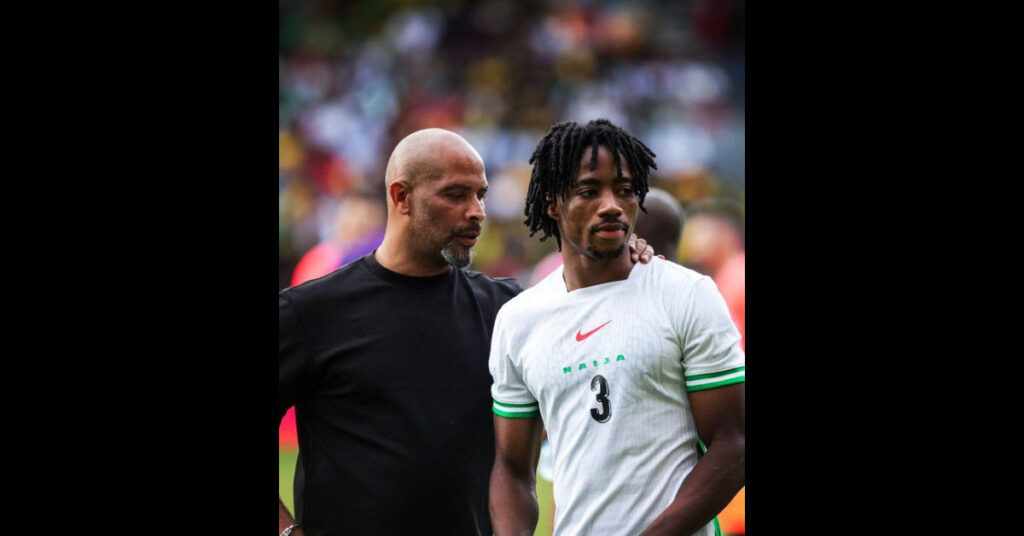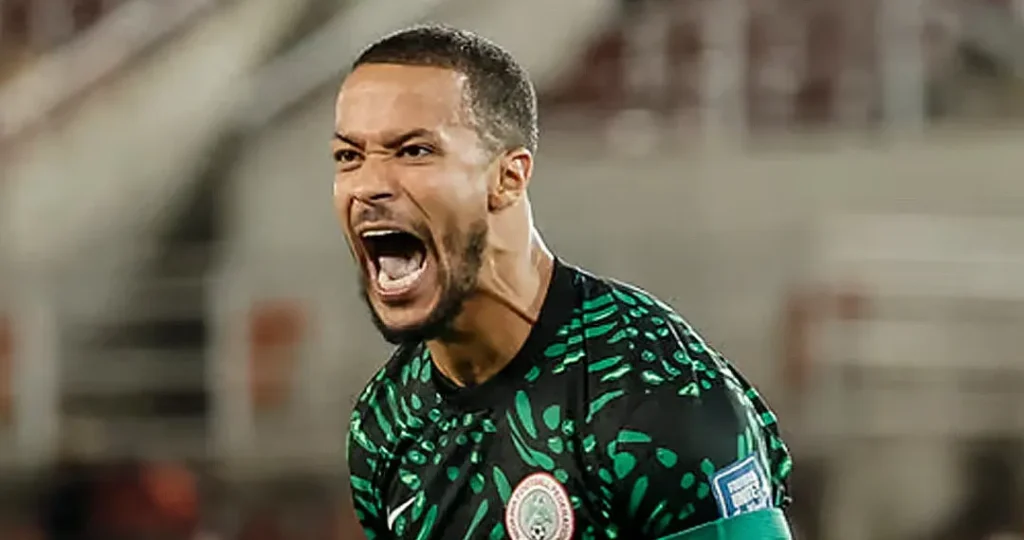
William Troost-Ekong is stuck in Doha with no flights out. Iran’s missiles have closed the skies across the Middle East — and the Super Eagles’ entire March schedule is now hanging by a thread.
This isn’t a transfer saga or a contract dispute. This is a Nigerian football legend, physically unable to leave a country caught in the middle of a military crisis. William Troost-Ekong, 32, is stranded in Qatar after Iran launched missile strikes targeting Gulf states on February 28, forcing the closure of airspace across the region — including Qatar, Kuwait, Jordan, the UAE, and Bahrain. As of Monday, March 2, 2026, Qatar Airways has confirmed that all flight operations remain suspended, with no reopening date confirmed.
Troost-Ekong joined Qatari club Al Ahli SC in January 2026, moving from Saudi Arabia’s Al Kholood. He had barely settled into life in Doha when the crisis erupted. Like hundreds of thousands of other travellers and expatriates caught across the Gulf, the former Super Eagles captain is going nowhere — not by choice, but because the skies above him are closed.
What Is Happening in the Middle East
On February 28, the United States and Israel launched coordinated strikes against Iran. Iranian state media confirmed that Supreme Leader Ali Khamenei and top security officials were killed in the attacks. Iran retaliated with ballistic missile and drone strikes aimed at Israel and four Gulf Arab nations hosting US military bases — Qatar, Bahrain, Kuwait, and the UAE.
Qatar’s air defence systems intercepted incoming missiles as part of a pre-planned security response. The Qatari Ministry of Defence confirmed the interceptions. As a direct consequence, Qatar and at least seven other countries across the region immediately shut their airspace, grounding all commercial and private flights.
Qatar Airways, which operates out of Hamad International Airport in Doha, announced on March 1 that operations would remain suspended until the Qatar Civil Aviation Authority declared the airspace safe. As of this morning, that declaration has not come. Over 3,400 flights have been cancelled across seven Middle Eastern airports, leaving hundreds of thousands of passengers stranded — Troost-Ekong among them.
- US and Israel launched strikes on Iran on February 28, 2026
- Iran retaliated with ballistic missiles targeting Gulf states
- Qatar, Kuwait, Jordan, UAE, Bahrain, and others closed airspace
- Qatar Airways suspended all flights — no reopening date confirmed
- Over 3,400 flights cancelled across the region as of March 2
- William Troost-Ekong among hundreds of thousands stranded in Qatar
Troost-Ekong: A New Chapter Frozen Mid-Start
There is a painful irony to Troost-Ekong’s situation. The 32-year-old had moved to Qatar just six weeks ago for a fresh start after spells in Saudi Arabia, Greece, and England. He signed a contract with Al Ahli SC until June 2028 — a deal that suggested he still had plenty of professional football left in him. Training sessions and league matches for Al Ahli have now been halted indefinitely as Qatari authorities focus on public safety.
He isn’t alone in the player community. Global stars including Marco Verratti, Philippe Coutinho, and Julian Draxler — all based in the Qatar Stars League — are reportedly facing the same predicament. But for Nigerian football fans, it’s Troost-Ekong’s face on this story. He’s the man who wore the armband for Nigeria through some of the most turbulent and triumphant moments in Super Eagles history.
It’s worth remembering that Troost-Ekong retired from international football in December 2025, after earning 83 caps and captaining the Super Eagles to the 2023 AFCON final. His international chapter is closed. But his club career is very much ongoing — and right now, it’s on an involuntary pause in a country under missile threat.
— Qatar Airways official statement, March 2, 2026
The Super Eagles’ March Window Is Now in Real Danger
The crisis extends well beyond Troost-Ekong’s personal situation. It goes straight to the heart of Nigeria’s football plans for March 2026.
The Nigeria Football Federation confirmed last month that the Super Eagles would participate in a four-nation invitational tournament in Amman, Jordan during the March FIFA international window. The schedule was set as follows:
- March 24: Super Eagles open camp in Amman
- March 27: Nigeria vs Iran, Amman International Stadium
- March 31: Nigeria vs Jordan, Amman International Stadium
- Costa Rica also confirmed as the fourth team in the tournament
That plan is now in serious jeopardy on multiple fronts. Iran’s participation looks almost impossible given the ongoing military conflict. Jordan’s airspace was also closed during the crisis, raising questions about whether Amman is even a safe or logistically viable venue. Coach Eric Chelle had already begun preparations — squad selection, tactical planning, player communication — only to see the entire framework threatened by events far beyond football’s control.
Tournament organisers have not announced any official changes as of Monday morning. FIFA has not issued guidance. The NFF is yet to confirm a contingency plan. The silence is telling — nobody knows what comes next.
What the NFF Must Do Now
This is where Nigerian football governance faces a real test. The March international window runs from approximately March 17 to April 1. The Super Eagles haven’t played since AFCON 2025 in Morocco. Coach Chelle needs competitive minutes for his squad ahead of what promises to be a busy summer. Losing this window entirely — or arriving in Jordan without Iran and with travel disrupted — would be a significant blow.
The NFF has three realistic options. First, push ahead with the Jordan tournament if the situation stabilises and Iran is replaced by another willing opponent. Second, relocate the tournament to a neutral, unaffected country entirely — Morocco, Egypt, or a European venue has all been used for emergency Super Eagles camps before. Third, pivot to domestic friendlies in Nigeria and use the window to build the internal squad and train.
None of these options is clean. All of them require fast decision-making from the NFF, FIFA, and the participating federations — bodies that don’t always move quickly even in normal circumstances. This is not a normal circumstance.
📊 Analysis: Three Angles on This Crisis for Nigerian Football
The safety angle: Troost-Ekong’s wellbeing comes first. Qatar’s missile interception systems worked, but the threat is ongoing. Qatar Stars League matches and training sessions have been suspended precisely because player welfare cannot be guaranteed while the region remains unstable. The NFF and Al Ahli SC will both closely monitor developments.
The planning angle: Coach Eric Chelle is building a Super Eagles squad for the future — new players, new system, new mentality after AFCON. The March window was his first chance to work with the group in a competitive environment since January. Losing that opportunity, or getting a heavily disrupted version of it, sets back his preparation timeline at a critical point in Nigerian football’s rebuild.
The bigger picture: This crisis is a reminder of how fragile international football logistics can be. Nigeria has players based in Saudi Arabia, Qatar, the UAE, and across the Gulf — leagues that have grown in prestige and attractiveness over the past decade. When geopolitical instability erupts in those regions, Nigerian football feels it directly. The NFF needs a proper crisis protocol for exactly these situations, and this episode should prompt a serious internal review.
A Story Still Unfolding
As of Monday afternoon, March 2, Qatar Airways has not confirmed a reopening time for Qatari airspace. Diplomatic channels between Iran, Israel, and the Gulf states are active but unresolved. Troost-Ekong remains in Doha with his Al Ahli teammates, waiting like everyone else for the skies to open.
The Super Eagles’ March plans remain officially unchanged — but the tournament as originally scheduled looks increasingly difficult to execute. FootballInNigeria.com.ng will continue to monitor both the regional situation and the NFF’s response as developments unfold.
What’s certain is this: Nigerian football is watching a geopolitical crisis through a very personal lens. A former captain stranded in a conflict zone. A national team’s preparation is in chaos. And a football federation that needs to act decisively before the window closes.
📌 Did You Know?
- William Troost-Ekong earned 83 caps for the Super Eagles across a decade of international football before retiring from national team duty in December 2025 — making him one of Nigeria’s most capped defenders in the modern era.
- Troost-Ekong was born in the Netherlands to a Dutch mother and Nigerian father. He chose Nigeria over the Netherlands as a teenager and went on to become one of the Super Eagles’ most influential captains.
- The former Super Eagles captain signed a contract with Al Ahli SC in Qatar until June 2028 — just six weeks before the airspace closure left him stranded in Doha.
- The four-nation tournament in Jordan was originally designed to give coach Eric Chelle valuable preparation time, with Nigeria’s Super Eagles not having played a competitive fixture since AFCON 2025 in Morocco in January 2026.
- Iran reportedly scored a goal against Iraq in a friendly match held just days before the crisis erupted — underlining how rapidly the regional situation deteriorated for football plans across the Gulf.
- Qatar’s Hamad International Airport, where Troost-Ekong and other stranded footballers are waiting for flights, is one of the world’s busiest transit hubs, handling over 45 million passengers annually before the crisis shutdown.
- This is not the first time a Middle East crisis has disrupted African football logistics. In 2019, Gulf tensions forced several national teams to reroute flights for AFCON qualifiers, costing federations significant additional expense and preparation time.