Former Super Eagles captain Sunday Oliseh has delivered a stark critique of Victor Osimhen’s on-field conduct at the 2025 Africa Cup of Nations (AFCON), claiming that a verbal outburst against teammate Ademola Lookman disrupted Nigeria’s momentum and contributed to their failure to win the tournament. Oliseh aired his views on his YouTube channel, asserting that the incident eroded team chemistry at a critical stage.
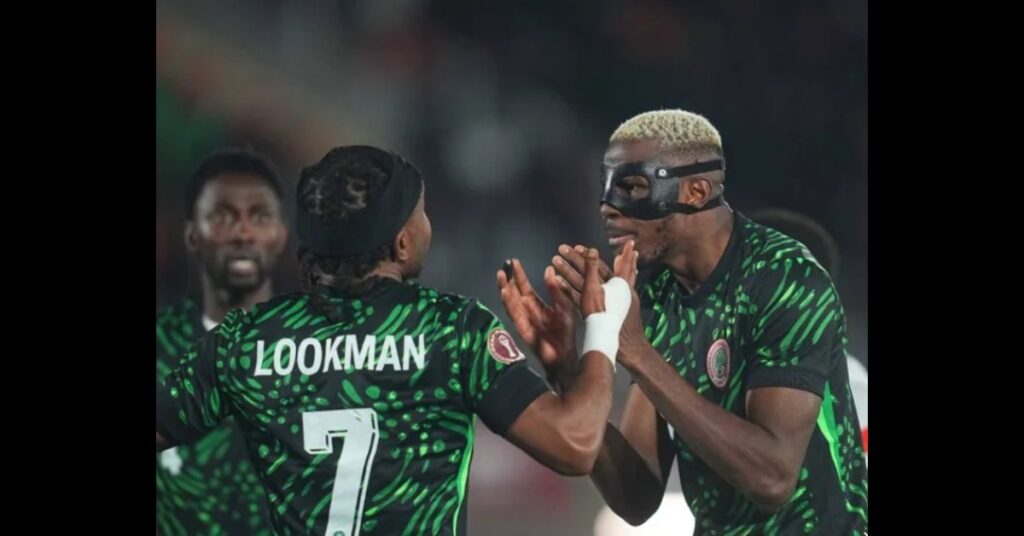
The confrontation occurred during Nigeria’s 4–0 Round of 16 victory over Mozambique, when Osimhen appeared to angrily rebuke Lookman in the 63rd minute after a key scoring chance was not played to him, even though Lookman had already created several openings for him earlier in the match. Although the Super Eagles advanced comfortably, Oliseh says the fallout was felt in the subsequent games.
Oliseh argued that Lookman’s form noticeably dipped after the incident, limiting Nigeria’s attacking threat in later fixtures, including their semi-final loss to Morocco. He suggests the public nature of the clash damaged the playmaker’s confidence and team unity intangible qualities he views as essential in knockout football.
The veteran also warned against prioritising individual talent over collective discipline, emphasising that even world-class players like Osimhen must respect teammates and team harmony. Oliseh’s comments have sparked debate among Nigerian football fans and pundits about leadership, attitude and accountability within the national squad.
EDITORIAL
In the theatre of elite sport, where razor-thin margins separate triumph from heartbreak, it is often the unseen forces psychology, cohesion, belief that determine outcomes as decisively as tactics or talent. Sunday Oliseh’s recent critique of Victor Osimhen’s public outburst directed at Ademola Lookman during AFCON 2025 touches on this very truth that individual brilliance, if unchecked, can unsettle the very fabric of a team’s collective purpose.
Osimhen’s stature in Nigerian football is indisputable. A global star who dominates defences with his physicality and goal threat, he embodies the modern striker’s dual role as scorer and psychological focal point. Yet Oliseh himself no stranger to the pressures of international football warns that talent without temperance can erode the intangible glue that binds a squad together. His assessment is not an attack on ability, but a reminder that leadership in football is as much about uplifting others as it is about self-promotion.
Football history is littered with examples of teams undone not by inferior skill but by fractured unity. A moment of frustration however human can echo longer than any goal scored. If Lookman’s performances indeed waned in the aftermath of the confrontation, it serves as a case study in how confidence, once dented, can affect not just one individual but the collective rhythm of a side poised on the brink of greatness.
Yet it would be reductive to ascribe Nigeria’s entire AFCON campaign outcome to a single altercation. Tournaments are long, opponents adapt, and myriad variables tactical choices, fatigue, luck influence results. What Oliseh’s critique does highlight is a broader cultural conversation about accountability, respect, and the balance between individual ambition and team unity themes as relevant off the pitch as on it.
In championing this perspective, Oliseh adds a layer to the ongoing discourse about what it means to wear one of football’s most cherished jerseys that greatness is measured not just in goals and accolades but in character and cohesion.
DID YOU KNOW?
- The incident between Osimhen and Lookman occurred in Nigeria’s 4–0 Round of 16 win over Mozambique at AFCON 2025, but the team still advanced comfortably from that match.
- Sunday Oliseh specifically argued that Lookman was statistically the most dangerous Nigerian player in the tournament before the confrontation.
- Oliseh insists that public clashes within a squad can erode ‘psychological edge,’ a quality he believes Nigeria needed against tactically disciplined teams like Morocco.
- Nigeria ended AFCON 2025 with a bronze medal after beating Egypt in a penalty shootout, despite Oliseh’s view of an interrupted championship bid.
- Victor Osimhen’s altercation with Lookman was not the only controversial moment in his recent national team tenure Oliseh also referenced a past public disagreement Osimhen had with former coach Finidi George.