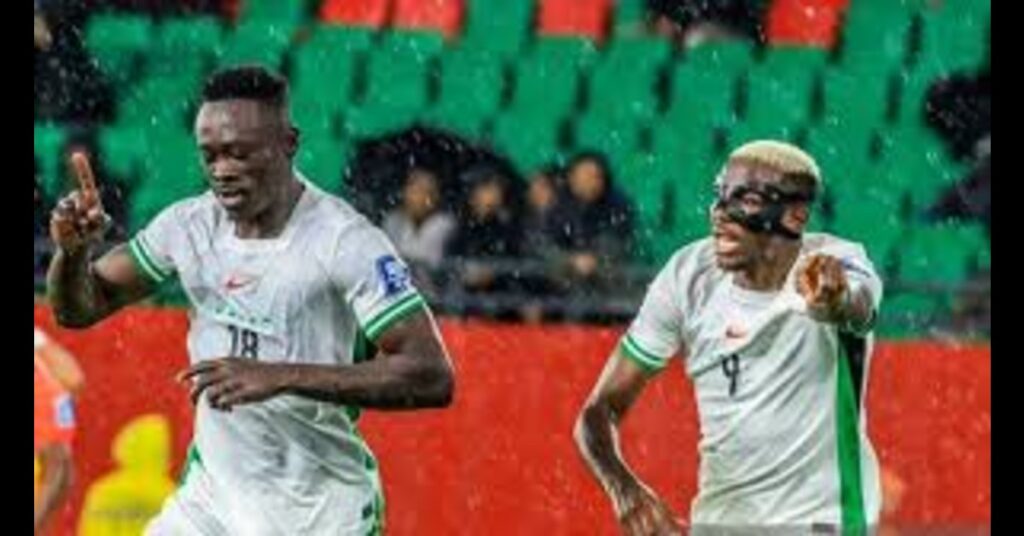
The Super Eagles secured a commanding 4-1 victory over Gabon National Football Team in Rabat to book their place in the final of the 2026 FIFA World Cup African play-offs. After a tense 1-1 draw following 90 minutes, Nigeria raised their intensity in extra time and carved out the result with ruthless efficiency.
The breakthrough came in the 78th minute when Akor Adams (Sevilla) struck from inside the box, giving the home side the lead after sustained pressure. Then, just as it looked like Nigeria would hold on in regulation, Gabon hit back late Mario Lemina equalised in the 89th minute, forcing the contest into extra time.
In extra time, Nigeria were simply superior. Chidera Ejuke doubled the lead in the 97th minute with a composed finish, before Victor Osimhen took centre stage first with a fine strike in the 102nd minute and then adding his second in the 110th to seal the emphatic win.
Looking ahead, Nigeria will face the victor of the semi-final between Cameroon National Football Team and DR Congo National Football Team on Sunday, November 16, with a place in the inter-confederation play-offs and a renewed shot at the 2026 FIFA World Cup at stake.
Editorial
The Super Eagles’ triumph over Gabon was less a cameo and more a proclamation of intent. In Rabat, Nigeria did not simply win they dominated a pivotal juncture in their World Cup journey, stamping their authority when it mattered most.
Opportunistic, determined and brimming with attacking verve, this was a Nigeria side that seemed to have shed the indecision of past campaigns. Adams’ opener in the 78th minute arrived in the fertile hour when tension might have reigned, but instead of becoming tentative, the Eagles pressed. When Gabon equalised in the 89th minute, many might have seen momentum ebbing away. Yet Nigeria did the opposite they reshaped the contest in extra time.
Ejuke’s second was a moment of composure in a match that could easily have spiralled. And then Osimhen, with his twin goals, assumed the mantle of leader, carrying the hopes of a nation on his broad shoulders. We should not understate the significance of this beyond the goals, it was the shift in temperament, the resilience. Nigeria looked like a team that believed deep down it belonged at this level.
There are echoes here of other African nations who seized decisive moments, who blended speed, strength and strategic nous to transcend expectation. It is not enough to reach this stage what defines progress is the capacity to flourish under the glare of qualifying pressure. Nigeria, on this evidence, did so.
But the journey is far from over. The final against either Cameroon or DR Congo looms large, and with it the inter-confederation hurdle. History tells us that African qualification is as much about nerve as it is about skill. Nigeria have laid down a marker; now they must carry that self-belief forward. If they do, the world stage beckons.
Did You Know?
- Nigeria’s extra-time surge in this match marks the first time the Super Eagles have scored three goals in extra time of a World Cup qualifying play-off.
- Victor Osimhen’s brace in this fixture takes his goal-tally for the national side into double figures in competitive matches.
- Chidera Ejuke became the first Nigerian substitute to score in extra time of a FIFA World Cup play-off since 1998.
- Akor Adams’ opener in the 78th minute was Nigeria’s first goal scored after the 75th minute in any World Cup qualifying match since 2013.
- The venue, Rabat, hosted a World Cup qualifier for the first time in this play-off series Nigeria are now the first visiting side to win a play-off tie there in extra time.