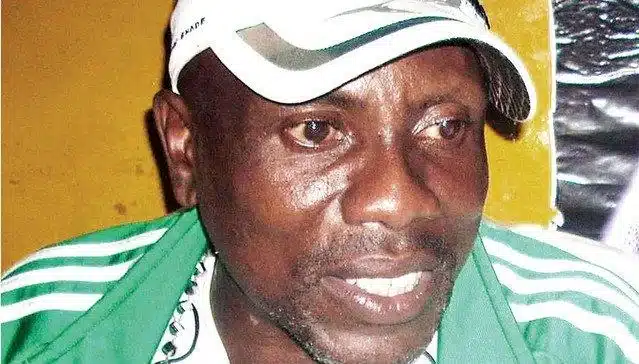
Etim Esin, the man Diego Maradona asked about at USA ’94, has broken decades of silence to reveal that missing Nigeria’s historic World Cup debut pushed him into cocaine addiction and suicidal thoughts.
He was supposed to be there. Etim John Esin, the gifted attacking midfielder from Oron in Akwa Ibom State who had starred in six of Nigeria’s 1994 World Cup qualifying matches, was expected to be part of the golden generation that would take Nigerian football to the global stage for the first time. Instead, he watched from the outside as his teammates made history in the United States. The pain of that exclusion, he has now confessed, broke him completely.
Speaking on the Play Zone Podcast, the former Super Eagles star known as the “African Maradona” described the 1994 World Cup snub as the defining wound of his life. “My greatest regret was not playing at the World Cup,” he said. “That led me to a lot of depression. I nearly committed suicide because I had a dream.”
The Scandal That Cost Him Everything
Esin’s omission from the squad was tied to a rape allegation in Belgium during his time with KSC Lokeren, a case that ultimately led to a FIFA ban. The allegation, which involved a 16-year-old, proved devastating for his career even though it was later proven to be false more than 25 years after the events. Coach Clemens Westerhof, he claims, used the scandal as grounds to keep him out of the squad despite the fact that, as Esin pointedly noted, approximately 90 percent of the 1994 World Cup squad were players based in Belgium at the time.
“At that time, 90% of that USA ’94 team players were based in Belgium, where I was playing before the rape issue. So why couldn’t I have been among them?” Esin said. “I should have been there, but Westerhof stopped me.” The accusation that Westerhof made a personal rather than football decision is one Esin has carried for over three decades. New Nigerian football fans who want to bet on the Super Eagles’ next generation can find how to get your Bet9ja promotion code ahead of the AFCON 2027 campaign.
Abiola’s Promise and Its Collapse
Adding cruelty to heartbreak was the timing of events around Chief MKO Abiola. The Presidential candidate, whose election victory in June 1993 was subsequently annulled, had personally promised Esin a leadership role in the World Cup squad. Abiola even stepped in financially to help Esin navigate the Belgian legal case, sending money and paying lawyers on his behalf. When Abiola was locked up following the annulment of his election result, that safety net collapsed entirely.
“Abiola promised me that if I win the election, you will captain the team to the World Cup,” Esin recalled. “You know, this life in a split second can just turn around. Abiola was locked up. The World Cup was the only dream I had.” With his protector gone and his reputation in ruins, Esin had no path back into the squad. He watched from a distance as Nigeria advanced from their group at USA ’94 before losing narrowly to Italy in the Round of 16 in a campaign still celebrated as one of Africa’s finest World Cup performances. Fans can use the YOHAIG promo code to follow the Super Eagles’ next chapter on Bet9ja.
Even Maradona Asked About Him
The most striking detail from Esin’s confession is what happened inside the Nigeria camp during the tournament itself. Late goalkeeper and captain Peter Rufai, who captained Nigeria in the group stage fixture against Argentina, later told Esin something that cuts to the bone: Diego Maradona himself had asked about the Nigerian midfielder during the match.
“Even the late Peter Rufai, because he captained the team against Argentina, asked where the African Maradona was. So you can imagine how it was very painful for me at that time,” Esin said. Maradona reportedly turned to Rufai during the match and asked: “Where is your own Maradona?” It is the kind of detail that tells you everything about the player Esin was, and everything about what he lost.
Cocaine, Depression and the Road Back
Unable to process the loss, Esin fell apart. He has now acknowledged publicly, for the first time in such direct terms, that the depression that followed drove him to cocaine. “Because I would not believe that after the 90s, I would not also be part of the squad to the ’94 World Cup. That’s why I went into drugs. I was so depressed that I went into drugs. I was taking cocaine,” he said. The confession is remarkable both for its honesty and for what it says about the mental health toll that elite football can extract from players who fall just short of their defining moment.
His relationship with the late Stephen Keshi added another layer of regret. The two men never got along, and Esin has since admitted that his refusal to heed Keshi’s advice about discipline was a critical error. “Had I followed his advice, maybe my career could have taken a different turn,” Esin said in a separate reflection on Keshi’s legacy. New readers following this story can also claim Bet9ja’s YOHAIG code to get started on the platform as Nigerian football rebuilds toward AFCON 2027.
Today, Esin works as a counsellor on discipline issues and advocates for the protection of emerging talents in Nigerian football. The man whose dribbling once drew comparisons to Maradona has channelled the wreckage of his career into something constructive. But the pain of USA ’94, he makes clear, has never fully left him.
📌 Did You Know?
- Etim Esin earned the nickname “African Maradona” during his time in the Belgian league, where his dribbling and vision were considered exceptional enough that Diego Maradona himself enquired about him during Nigeria’s 1994 World Cup group stage match against Argentina.
- Esin featured for Nigeria’s Flying Eagles at the 1987 FIFA World Youth Championship in Chile, which remains the only senior global tournament appearance on his record. That youth squad was considered one of the most talented Nigeria had ever produced.
- At KSC Lokeren in Belgium, Esin made 110 appearances and scored 18 goals across his professional career, figures that reflect consistent impact rather than a peripheral presence in European football.
- The rape allegation that ended Esin’s European career was proven to be false more than 25 years after the incident, a vindication that came far too late to restore what he had lost in 1994.
- MKO Abiola, who personally funded Esin’s legal defence in Belgium, was declared the winner of Nigeria’s June 1993 presidential election before the military government annulled the result. He was subsequently detained and died in custody in 1998.
- Nigeria’s 1994 World Cup squad featured players almost exclusively based in Belgium at the time, including Finidi George, Sunday Oliseh, and Rashidi Yekini, making Esin’s exclusion all the more pointed given his own base in that league.
- Esin’s career at AA Gent in Belgium began in 1986 after scouts watched him score twice against Iwuanyanwu Nationale for Flash Flamingoes. He was just 17 years old at the time, and the goals were enough to earn him a contract without a formal trial.