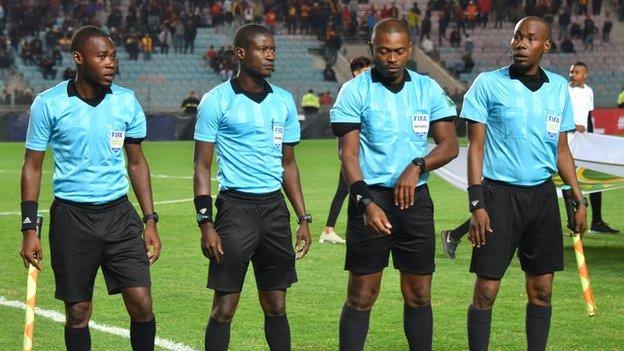
It has been nearly two decades since a Nigerian referee took charge of a match at the Africa Cup of Nations, and the federation’s latest training push is an attempt to finally close that gap.
Want our football coverage to show up first?
Add FootballInNigeria as a preferred source and our stories get a "Preferred" badge in your Google Top Stories, AI Overviews, and AI Mode results.
Nigerian football referees have been issued a direct charge to raise their domestic performance standards in order to improve their chances of selection for continental and global officiating assignments, as reported by FootballInNigeria.com.ng. The charge came from Nigeria Football Federation general secretary Dr Mohammed Sanusi at the conclusion of a FIFA Member Association Course for elite referees held in Abuja.
The two week programme ran from 7 June to 19 June and formed part of the federation’s ongoing effort to keep Nigerian match officials aligned with current global standards in officiating, a sector where the country has fallen well behind its African peers in recent years.
What the Course Covered
Sanusi explained that while the course was primarily designed for elite officials, its curriculum extended to rules governing youth football, beach soccer, and FIFA-badged referees, including those who officiate Nigeria Professional Football League matches and international fixtures. FIFA representatives were deployed to Abuja specifically to brief Nigerian referees on the newest amendments to the Laws of the Game, the same rule changes currently being applied at the ongoing FIFA World Cup in the United States, Canada and Mexico.
According to Sanusi, those amendments are due to come into full domestic operation from 1 July, and he has instructed the referees who attended the course to apply everything they learned in practice so that Nigerian officiating standards can begin closing the gap with the rest of the continent. His underlying message was straightforward better performances domestically are the only route back to international recognition.
Fans following Nigerian football and the NPFL’s officiating standards this season can check the YOHAIG promo code ahead of the new campaign.
The Scale of the Problem Sanusi Is Trying to Fix
The urgency behind this training push becomes clearer when measured against Nigeria’s recent officiating record. The country has gone without a centre referee at the Africa Cup of Nations finals for almost two decades, with Emmanuel Imiere’s appointment for a Group B fixture at the 2006 AFCON in Egypt remaining the last time a Nigerian took charge of a match at the tournament. Nigeria’s most recent presence in any officiating capacity at AFCON came in 2015, when Peter Edibi served as an assistant referee in Equatorial Guinea.
The drought has continued in the years since. No Nigerian official featured among the 73 strong team of match officials at the 2025 AFCON in Morocco, and no Nigerian referee was even selected for the mandatory CAF preparatory course that serves as a prerequisite for tournament selection. That omission carried direct consequences for the 2026 World Cup as well. When CAF and FIFA confirmed their list of African match officials for the tournament in the United States, Canada and Mexico, seven centre referee slots went to officials from Algeria, Egypt, Gabon, Morocco, Mauritania, South Africa and Somalia. None went to Nigeria.
Supporters who want to follow Nigerian football’s officiating standards and the NPFL season can check the Bet9ja’s current promo code as the new campaign approaches.
Where the Bottleneck Really Sits
Stakeholders within Nigerian football have pointed to a mix of factors behind the country’s officiating decline, including concerns around integrity, favouritism and inconsistent capacity development at the federation level. CAF, for its part, places heavy weight on rigorous physical fitness testing, theoretical assessment, and practical command of the Video Assistant Referee system, areas where Nigerian officials have struggled to keep pace with continental rivals who have become regular fixtures at major tournaments.
That contrast is stark when set against countries like Mauritania and Algeria, whose referees have become familiar names at CAF finals and now World Cup assignments, built on consistent exposure to high level continental club competition. Nigerian officials have largely been absent from that pipeline, a gap that domestic course attendance alone cannot fully solve without sustained exposure to higher stakes matches.
A Long Road Back to Relevance
Sanusi’s charge to the referees who completed the Abuja course reflects an awareness within the NFF that the problem requires sustained attention rather than a single training intervention. Getting Nigerian officials back into AFCON and World Cup contention will likely require not just better theoretical knowledge of the Laws of the Game, but consistent high pressure match exposure in continental club competitions, the kind of track record CAF now expects before it will trust a referee with its biggest stages.
For now, the federation’s message to its referees is clear domestic performance is the only lever they fully control, and improving it is the necessary first step before international recognition can follow. Whether that translates into a Nigerian referee finally returning to AFCON or World Cup duty remains to be seen, but the Abuja course represents at least an acknowledgment that the current trajectory needs to change.
Fans who want to follow NPFL officiating standards and Nigerian football’s broader development can find a useful breakdown at this Bet9ja promo code today guide ahead of the new season.
📌 Did You Know?
- Emmanuel Imiere remains the last Nigerian referee to officiate a match at the Africa Cup of Nations finals, taking charge of a Group B fixture between Zambia and Guinea at the 2006 tournament in Egypt.
- Despite the AFCON officiating drought, FIFA cleared 30 Nigerian referees and assistant referees for international duty in 2026, showing the country still maintains a sizeable pool of FIFA badged officials even without major tournament selections.
- No Nigerian referee, assistant referee, or VAR official was selected for the 2026 FIFA World Cup, with CAF’s seven centre referee slots instead going to officials from Algeria, Egypt, Gabon, Morocco, Mauritania, South Africa and Somalia.
- Jean-Jacques Ndala of DR Congo, who took charge of the controversial 2025 AFCON final between Senegal and Morocco, was notably left off the 2026 World Cup officiating list following the fallout from his decisions in that match.
- CAF’s growing emphasis on Video Assistant Referee competency has become one of the clearest dividing lines between officials who progress to major tournaments and those who remain confined to domestic competitions.
- Nigeria’s absence from AFCON officiating has now stretched for close to two decades, a period during which countries like Mauritania and Algeria have produced multiple referees who have become regular fixtures at continental finals.
- The FIFA Member Association Course held in Abuja from 7 to 19 June 2026 was specifically timed to brief Nigerian officials on Laws of the Game amendments before their mandatory domestic implementation from 1 July.