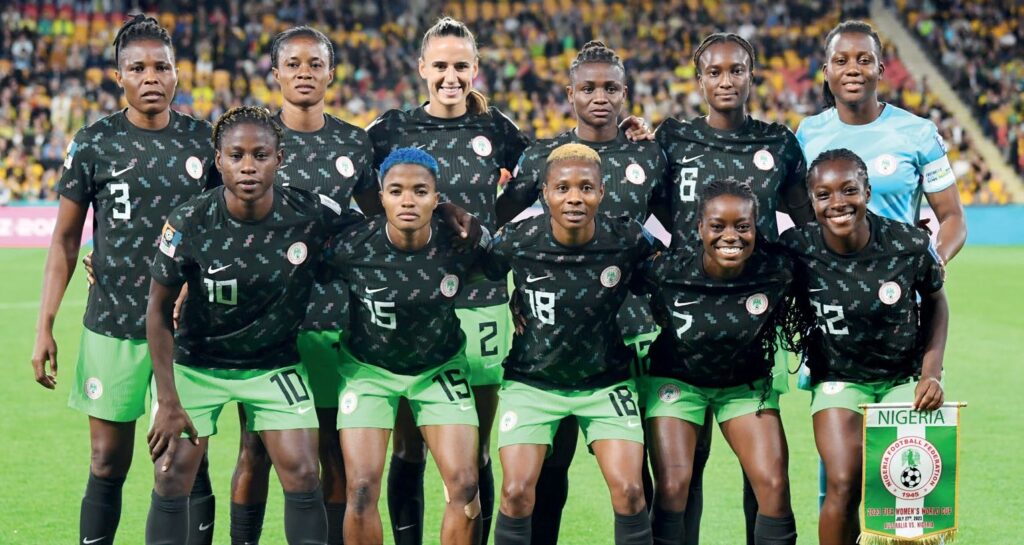
The Nigeria Football Federation and UNICEF have commenced formal talks toward a Memorandum of Understanding that will see Super Falcons players deployed as ambassadors for polio eradication and girl child protection campaigns, with Nigeria’s U-20 and U-17 women’s teams also set to participate.
The Super Falcons are preparing to take their influence beyond the football pitch in a formal partnership that will place Nigeria’s senior women’s players at the centre of two of the country’s most pressing public health and social welfare campaigns. The NFF confirmed on Wednesday that officials from UNICEF visited the federation’s secretariat in Abuja to begin discussions that both parties expect to formalise through a Memorandum of Understanding covering a range of advocacy activities aimed at improving the lives of Nigeria’s children.
Leading the UNICEF delegation was Lone Hvass, the organisation’s Chief of Communication, Advocacy and Partnership, who was accompanied by Communication Specialist Susan Akila and Samuel Kaalu from UNICEF’s Kano Field Office. The NFF’s side of the table included General Secretary Dr Mohammed Sanusi, Director of Media and Communications Ademola Olajire, Director of Competitions Ruth David, Director of Finance and Administration Rajan Zaka, Director of Marketing and Sponsorships Alizor Chuks, and Head of International Competitions Enebi Achor.
Want our football coverage to show up first?
Add FootballInNigeria as a preferred source and our stories get a "Preferred" badge in your Google Top Stories, AI Overviews, and AI Mode results.
Nigerian football supporters can follow the Super Falcons’ off-pitch work alongside their WAFCON preparations with the Bet9ja latest offer as the partnership between the NFF and UNICEF develops through the coming months.
What UNICEF Is Asking The Super Falcons To Do
Hvass was direct about UNICEF’s ambition for the partnership. The organisation wants Super Falcons players to become recognisable public voices on polio vaccination and broader child welfare issues, lending their profile to campaigns that grassroots health workers alone cannot reach. “Our objective is to engage a couple of players of the Super Falcons to speak out about polio, raise awareness, and address other key issues affecting children,” Hvass told the NFF. “We have had successful collaborations in the past with great Nigerian ambassadors from football, and we believe role models from sport are extremely powerful for these campaigns. Families and even the children pay attention when trusted, well-known figures speak on these issues.”
The framing matters. UNICEF’s approach is built on a well-documented principle: that celebrity and sporting figures can reach communities which are resistant to conventional public health messaging, particularly in areas where distrust of government institutions runs high. Nigeria has faced persistent challenges with vaccine hesitancy, particularly in parts of the north, and UNICEF’s own field experience in states like Bauchi, where over 100,000 children are classified as zero-dose, underlines how much ground remains to be covered.
Beyond polio, the partnership agenda also includes campaigns against child molestation, which Sanusi confirmed as one of the areas both organisations discussed during Wednesday’s meeting. The inclusion of child protection alongside public health reflects UNICEF’s broader mandate in Nigeria and suggests the partnership will carry genuine social depth rather than functioning as a simple endorsement exercise.
Extending The Campaign To The Falconets And Flamingos
One of the more significant details to emerge from Wednesday’s meeting was UNICEF’s stated intention to extend the ambassador programme beyond the senior Super Falcons. Hvass indicated that players from Nigeria’s U-20 women’s national team, the Falconets, and the U-17 side, the Flamingos, could also participate in the advocacy programmes, with the explicit aim of broadening the campaign’s reach among younger audiences.
The reasoning is straightforward. Younger national team players carry credibility with a different segment of the population to senior stars. A Flamingos or Falconets player speaking about polio vaccination in a school or community setting will resonate with children of a similar age in a way that a more senior international figure cannot always replicate. UNICEF’s combination of senior and youth players, if the partnership develops as discussed, would give the campaign a genuine multi-generational character that could meaningfully extend its impact across Nigeria’s regions. Readers who want to back the Super Falcons ahead of their WAFCON title defence can check the Bet9ja YOHAIG welcome offer for the latest registration deals.
The NFF’s Response And What It Signals
Dr Sanusi’s response to the UNICEF approach was unambiguous. The NFF General Secretary expressed clear appreciation for UNICEF Nigeria’s objective of child development, describing it as a topic the current NFF leadership cares deeply about. His framing of the discussion was not that of a federation being asked to do a favour for an international organisation, but of two institutions discovering a shared purpose that both have reason to pursue seriously.
That framing matters because the NFF’s willingness to commit senior figures from across its administrative departments to the initial meeting suggests institutional seriousness rather than a courtesy conversation. The presence of directors from media, competitions, finance, marketing, and international competitions at a preliminary discussion about a social advocacy partnership is a signal that the federation sees this as something it intends to pursue properly.
The timing of the partnership talks is also notable. It comes in a year when the Super Falcons are preparing to defend their WAFCON title and the Falconets are preparing for the 2026 FIFA U-20 Women’s World Cup in Poland. Both squads will carry heightened national and international visibility through the second half of 2026, giving any campaign attached to Super Falcons and Falconets players a larger audience than it would have in a quieter period of the women’s football calendar.
Why Sport Makes Sense For This Kind Of Campaign
UNICEF has used sporting figures in public health campaigns across Africa for decades, and the evidence base for the approach is strong. Athletes carry trust that politicians, health officials, and even community leaders often do not, particularly among young people and in households where football is a daily cultural reference point. In Nigeria, where the Super Falcons have won the Africa Cup of Nations a record eleven times and the players command genuine public admiration, the potential reach of well-executed campaigns is significant.
The polio angle is particularly urgent. Nigeria was removed from the WHO’s list of polio-endemic countries in 2020, a historic public health achievement. Maintaining that status requires continuous vaccination coverage, and UNICEF’s field data from 2025 shows that vaccine hesitancy and zero-dose children remain serious concerns in several northern states. A Super Falcons player speaking publicly about why vaccination matters, in the way that a Kelechi Iheanacho or a Victor Osimhen might be deployed for a men’s team equivalent, could shift the needle in communities where conventional outreach has stalled.
As reported by FootballInNigeria.com.ng, the NFF and UNICEF are expected to finalise the terms of their formal partnership in the coming weeks, with campaign activities anticipated to begin before the end of 2026. For supporters who want to follow the Super Falcons through both their on-pitch and off-pitch contributions to Nigerian society, the Bet9ja virtual sports page carries the latest offers for engagement with Nigeria’s football calendar.
📌 Did You Know?
- Nigeria was officially declared free of wild poliovirus by the World Health Organisation in August 2020, becoming the last country in Africa to achieve that milestone and completing the continent’s certification as polio-free. Maintaining that status requires sustained vaccination coverage, which is the context behind UNICEF’s continued advocacy work in Nigeria.
- The Super Falcons have won the Africa Women Cup of Nations a record eleven times, more than any other nation on the continent, making their players among the most recognised and admired female athletes in African sports history.
- UNICEF Nigeria maintains field offices across the country, including in Kano, reflecting the organisation’s particular focus on northern states where child welfare challenges including vaccine hesitancy, child marriage, and limited girls’ education access are most acute.
- Dr Mohammed Sanusi, who led the NFF’s side of the UNICEF discussions, is a qualified medical doctor in addition to being a senior football administrator, giving the federation’s response to the health-focused partnership an additional dimension of personal alignment with its subject matter.
- Nigeria’s U-17 women’s national team, the Flamingos, became the first African side to reach the final of the FIFA U-17 Women’s World Cup when they played in the 2022 edition in India, reaching the title match before losing to Spain. Their profile with younger Nigerian audiences makes them a natural fit for campaigns targeting school-age children.
- UNICEF’s Lone Hvass referenced successful past collaborations with Nigerian football ambassadors during Wednesday’s meeting, a reference that includes previous partnerships with Super Eagles players during earlier polio and child survival campaigns that predate the current NFF leadership.
- The 2026 FIFA U-20 Women’s World Cup in Poland, for which the Falconets have already qualified and been placed in Pot 2 for the draw in Lodz, gives the Falconets unprecedented international visibility that could amplify any UNICEF-branded campaign they participate in before or during the tournament.