
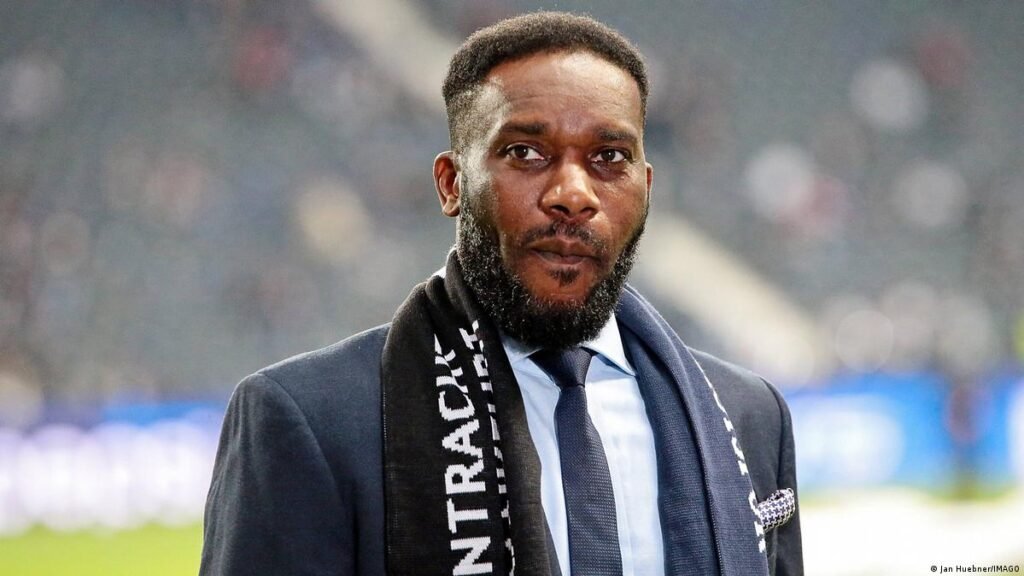
Jay-Jay Okocha has pinpointed the one quality that separates Nigerian footballers from South Africans in European football, and it has nothing to do with technique. It comes down to hunger.
The Hunger to Leave Home
Austin Jay-Jay Okocha knows exactly what it takes to make it in Europe as an African footballer. He did it himself, leaving Nigeria at 17 on nothing more than a visiting visa to Germany, walking into a third-division training session at Borussia Neunkirchen, and building a career that would take him to Eintracht Frankfurt, Fenerbahce, Paris Saint-Germain, Bolton Wanderers, and beyond. So when he speaks about why Nigerians succeed abroad, he isn’t guessing. He’s talking from lived experience.
Speaking on Thabisa Mosia’s Game On show on Radio 2000, the former Super Eagles captain gave a sharp, unfiltered assessment. “South African players are too comfortable at home. That drive is not really there. But we Nigerians are very ambitious. We like to challenge ourselves,” Okocha said. It’s not the first time he’s framed this argument, but coming from a man who is widely regarded as one of the greatest African footballers of all time, it carries real weight.
Want our football coverage to show up first?
Add FootballInNigeria as a preferred source and our stories get a "Preferred" badge in your Google Top Stories, AI Overviews, and AI Mode results.
Okocha’s Own Story Proves the Point
Okocha’s path to European stardom was never smooth or planned. He travelled to West Germany in 1990 as a visitor, accompanying a friend to a Borussia Neunkirchen training session on a whim. The coach was impressed enough to offer him a contract on the spot. From that moment, Okocha grabbed every opportunity. “I left Nigeria not because I was comfortable. I went to Germany to try and see if I can get an opportunity to change my life,” he has said previously.
That’s exactly the mentality he’s now identifying as the difference-maker for Nigerian footballers as a generation. Players like Victor Osimhen chased moves to Wolfsburg and Lille before exploding at Napoli. Ademola Lookman bounced through Charlton, Everton, and RB Leipzig before finding his best form at Atalanta, winning the Europa League in 2024 and then earning a move to Atletico Madrid. Terem Moffi travelled through Lithuania, Belgium, and France before landing at FC Porto. These aren’t comfortable paths. They’re uncomfortable ones chosen deliberately.
The South Africa Comparison Is Nuanced
Okocha was careful not to dismiss South African football entirely. In fact, he acknowledged that Bafana Bafana’s qualification for the 2026 World Cup, at Nigeria’s expense no less, is a legitimate achievement. “It’s happy days for South African football, and it’s well deserved because they worked for it,” he said. South Africa’s domestic Premier Soccer League, he noted, has real strength. Many of Bafana’s key players come from that league, not from European clubs.
But that’s also the point. South Africa qualified for the World Cup largely with domestically based players. Nigeria, whose squad at the 2025 AFCON in Morocco contained zero NPFL players, relies entirely on Europe-based talent. The irony is plain: Nigeria produces more European-based players, yet South Africa reached the World Cup and Nigeria didn’t. Okocha’s argument explains why Nigerians succeed in Europe individually, but it doesn’t resolve the structural question of why that individual excellence hasn’t translated into collective qualification success.
The Present Generation Carrying the Tradition Forward
The current crop of Nigerian players is arguably the most talented the country has ever produced in Europe simultaneously. Osimhen at Galatasaray. Lookman at Atletico Madrid. William Troost-Ekong marshalling defences across the continent. Terem Moffi at FC Porto. Alex Iwobi at Fulham, whom Okocha himself has mentored. This is a generation that is living out the ambition Okocha described, getting out of the comfort zone and competing at the highest levels.
Okocha’s point, though, is that the attitude starts before any of that. “To truly excel, you must aspire to become the best version of yourself,” he said. That aspiration is deeply embedded in Nigerian football culture, from street football in Lagos and Enugu, to the academies across the south-south, to the under-age tournaments that feed talent into Europe’s recruitment pipelines. It’s a culture of restlessness. A refusal to stay where you are. That, Okocha argues, is Nigeria’s greatest football export. Not just the players. The mindset.
For fans keen to follow this exciting generation of Nigerian talent across the European leagues and continental competitions, the Bet9ja YOHAIG promo code gives you up to ₦100,000 in bonuses to back Nigerian stars competing on the biggest stages in club football.
A Legend Who Practised What He Preaches
It’s worth remembering that Okocha’s European adventure started at a third-division German club on a visiting visa. He went on to earn 73 caps for Nigeria, appear at three World Cups, and become arguably the most naturally gifted Nigerian footballer of his generation. Pele named him in the FIFA 100 list of the greatest living players. Bolton Wanderers fans chanted “Jay-Jay, so good they named him twice.” When he speaks about Nigerian ambition, he isn’t theorising. He’s the theory made flesh.
As reported by FootballInNigeria.com.ng, Okocha’s nephew Alex Iwobi has himself credited Okocha’s guidance as central to his own development, showing that the culture of ambition Okocha describes is being actively passed down to the next generation. That lineage matters. Nigerian football’s strength in Europe isn’t random. It’s inherited.
📌 Did You Know?
- When PSG signed Jay-Jay Okocha for £14 million in 1998, he became the most expensive African footballer in history at that time, a record that reflected how far Nigerian players had pushed into Europe’s elite clubs.
- Okocha scored a legendary solo goal against Oliver Kahn while playing for Eintracht Frankfurt in 1993. The goal was voted Germany’s Goal of the Year and remains one of the most celebrated individual moments in Bundesliga history.
- At Fenerbahce in Turkey, Okocha adopted the name “Muhammed Yavuz” to integrate into the local culture, scoring 30 goals in 62 appearances and becoming one of the club’s most beloved foreign players of that era.
- Jay-Jay Okocha’s nephew, Alex Iwobi, currently plays for Fulham and the Super Eagles, making the Okocha football lineage one of the most remarkable family connections in Nigerian football history. Okocha’s older brother Emmanuel also played for the Nigerian national team.
- Okocha represented Nigeria at three separate FIFA World Cups in 1994, 1998, and 2002, a feat only a handful of Nigerian players have managed across the country’s entire World Cup history.
- During his time at PSG, Okocha mentored a young Ronaldinho, who later won the 2005 Ballon d’Or. The Brazilian has credited his time with Okocha at PSG as an influence on his development as a creative attacking midfielder.
- Despite Nigeria’s strong presence in European football, the Premier Soccer League in South Africa produced enough quality players for Bafana Bafana to qualify for the 2026 World Cup ahead of Nigeria, their first World Cup appearance since 2010.