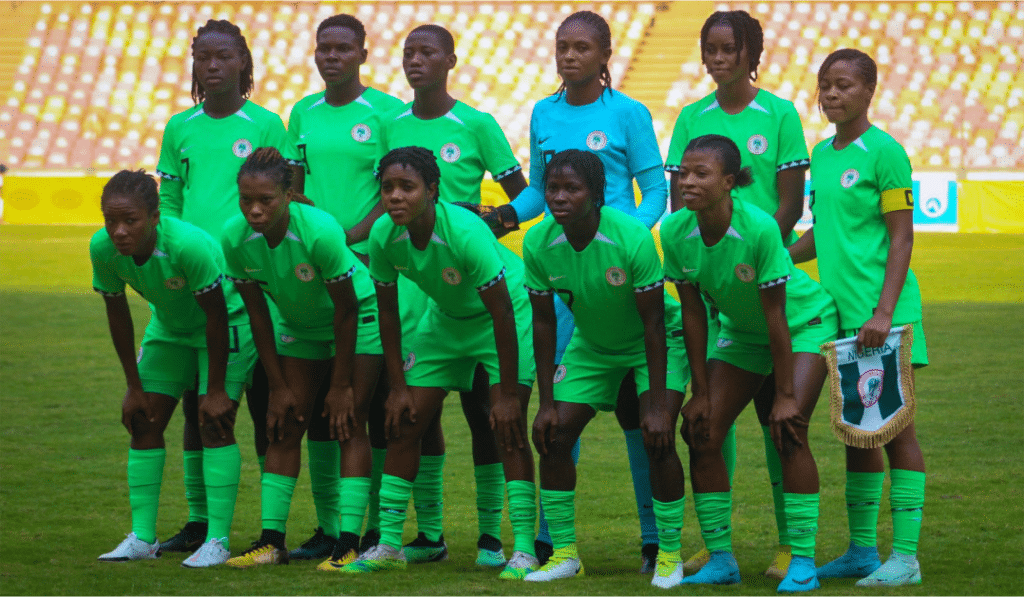

Nigeria’s Falconets will now host Senegal in the first leg of the 2026 FIFA U-20 Women’s World Cup third qualifying round in Abeokuta. The match will take place at the MKO Abiola Sports Arena, with the venue change sanctioned by the Confederation of African Football (CAF) following a request from the Nigeria Football Federation (NFF).
NFF’s Director of Competitions, Ruth David, said the shift was necessary because of the deteriorating condition of the pitch at the originally approved Lekan Salami Stadium in Ibadan. The Falconets had previously been scheduled to play at Ibadan, but the request to relocate was approved in time for the fixture.
The first leg in Abeokuta sets the stage for a two-legged tie, with the winner advancing further in the African qualifiers for a place at the global tournament.
Want our football coverage to show up first?
Add FootballInNigeria as a preferred source and our stories get a "Preferred" badge in your Google Top Stories, AI Overviews, and AI Mode results.
Editorial
There are moments in youth football that transcend mere logistics, where the venue becomes more than a backdrop it becomes a crucible for aspiration. Such is the case as the Falconets of Nigeria prepare to host Senegal in Abeokuta — not simply a shift on a map, but a recalibration of momentum on the path to the 2026 FIFA U-20 Women’s World Cup.
What might read as an administrative adjustment — the relocation from Ibadan’s Lekan Salami Stadium due to a substandard pitch carries deeper resonance. It is, at its core, an assertion of priority that the next generation of Nigerian female footballers deserves a stage worthy of their talent and ambition. In African qualification, where margins are fine and conditions unpredictable, the terrain upon which young feet chase the ball can shape both confidence and consequence.
Abeokuta’s MKO Abiola Sports Complex, now the designated venue, offers not merely turf but a psychological reset. For the Falconets two-time FIFA U-20 Women’s World Cup silver medallists the weight of history is both a banner and a burden. Qualification to this round came with authority a sweeping 5-0 aggregate triumph over Rwanda, a testament to their attacking verve and tactical coherence.
Yet Senegal, resurgent and resolute, arrive not as passive opponents but as contenders in their own right. In the broader context of African women’s youth football, this tie is a microcosm of evolving power balances — teams once viewed as peripheral now nipping at the heels of tradition. The Falconets know well that pedigree counts for little without execution on the day Senegal’s campaign hints at a nation eager to rewrite its own story on the global stage.
So Abeokuta will not merely host a match it will host a narrative. One of expectation, heritage and the delicate alchemy that turns promise into qualification. In a sport where youth tournaments often foreshadow the future of national programmes, this fixture is freighted with significance. On Feb. 7, when the whistle blows, the pitch will be a proving ground — for players, for coaches and for the broader ambitions that propel African football forward.
Did You Know?
- Nigeria’s Falconets have reached the FIFA U-20 Women’s World Cup final twice, finishing as runners-up in both 2010 and 2014, underlining their pedigree at youth level.
- Senegal’s women’s U-20 side has never qualified for the FIFA U-20 Women’s World Cup, making this qualifying tie one of the most significant in their history.
- The 2026 FIFA U-20 Women’s World Cup will be hosted in Poland, marking the first time the country has staged the women’s youth world finals.
- Abeokuta’s MKO Abiola Sports Complex is named after Chief MKO Abiola, a prominent Nigerian politician and philanthropist widely regarded for his contributions to democracy.
- CAF allocates only four slots to African teams for the U-20 Women’s World Cup finals, intensifying competition throughout the qualification phases.